Death Comes with Your Name: The Korean Jeoseung Saja Beyond the Saja Boys
If the Saja Boys from KPop Demon Hunters were your first encounter with the word “saja,” you are not alone.
They are stylish, dangerous, and unforgettable — exactly what K-pop fantasy does best. But behind that name, there is a much more interesting story: the Jeoseung Saja (저승사자), the messengers of the underworld who come when a person’s time has run out.
The Saja Boys are a brilliant modern reimagining. This article is not here to argue against them. But if you walked away from the screen wondering what “saja” actually means in Korean culture — you are asking exactly the right question.
Because “saja” is not just a character name. In Korean, 사자 (saja) means messenger or envoy. And 저승 (jeoseung) means the afterlife — the world beyond death. Put them together, and you get the Jeoseung Saja: the Messengers of the Afterlife.
They have existed in Korean folklore for centuries. And for those who first encountered them through KPop Demon Hunters, the real thing might be a little different from what you’d expect.
Not Exactly the Western Grim Reaper
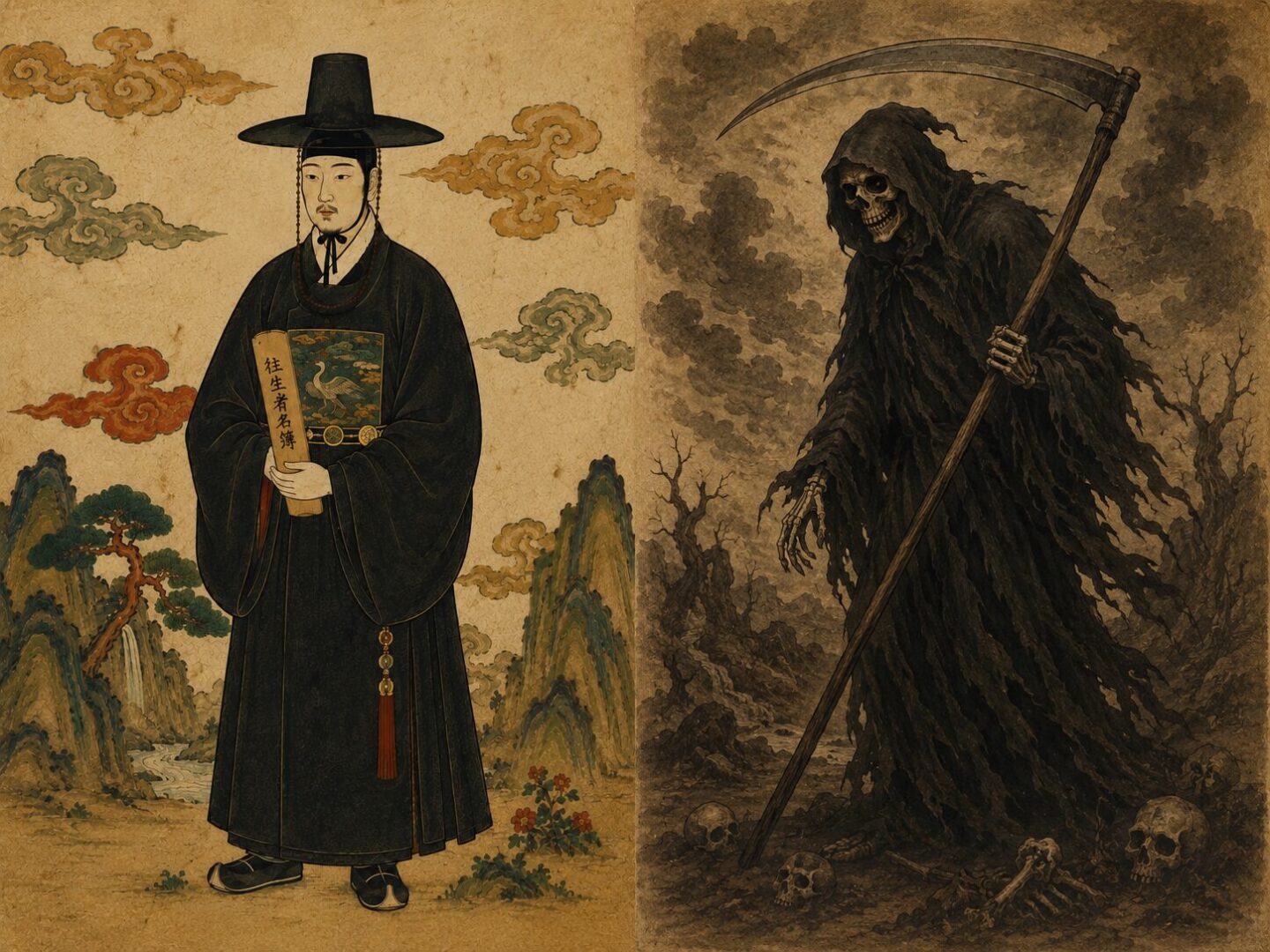
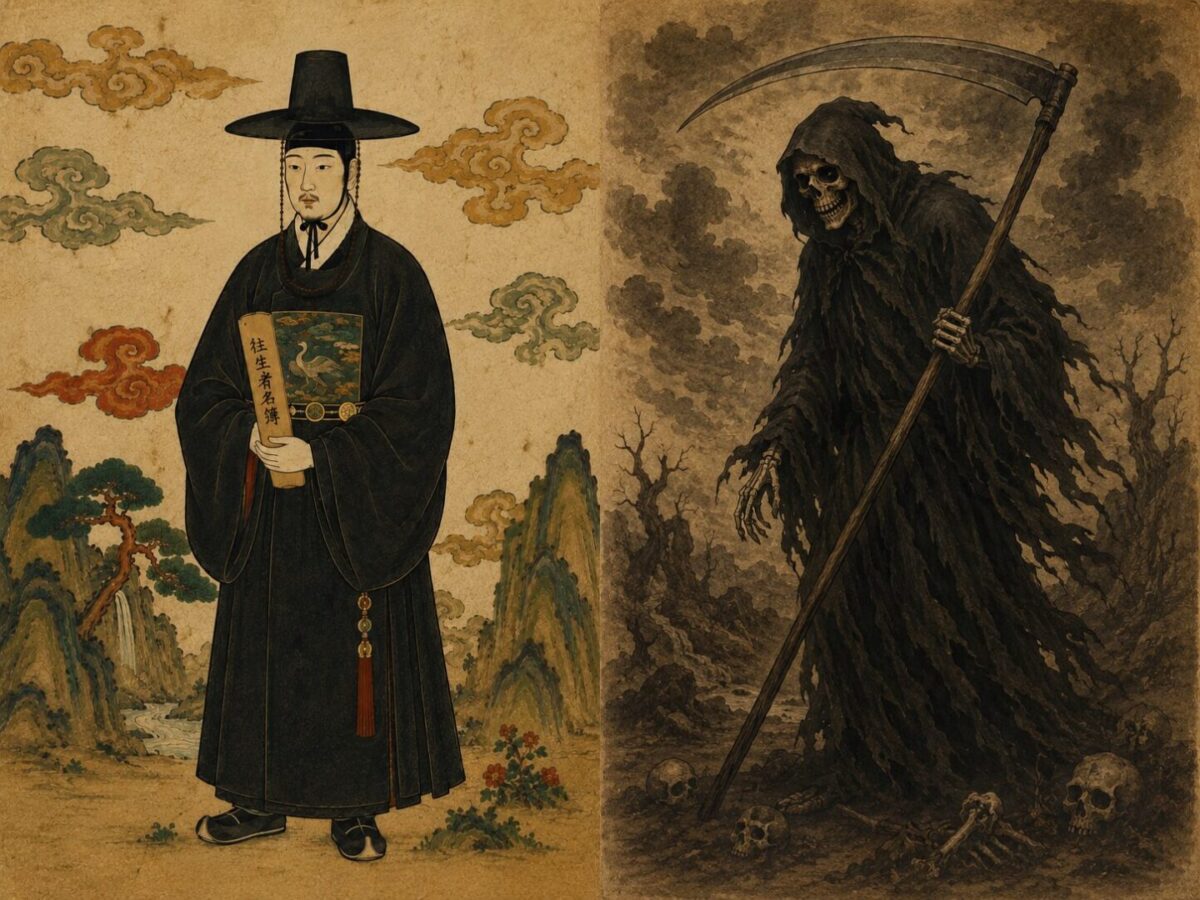
The Western Grim Reaper is a skeleton. They wear a black robe. They carry a scythe. Death personified — the final hunter, the darkness that takes you whether you are ready or not. Terrifying because they feel like a force of nature: something wild, inevitable, and outside of any human logic.
The Jeoseung Saja are different.
Many people translate Jeoseung Saja as the Korean Grim Reaper, but the comparison is not perfect. The Western Grim Reaper harvests souls. The Jeoseung Saja escort them.
They are not death itself. They are death’s representatives.
Think of it this way. The Grim Reaper feels like a predator. The Jeoseung Saja feel like officials — authoritative, composed, and entirely certain of why they are there.
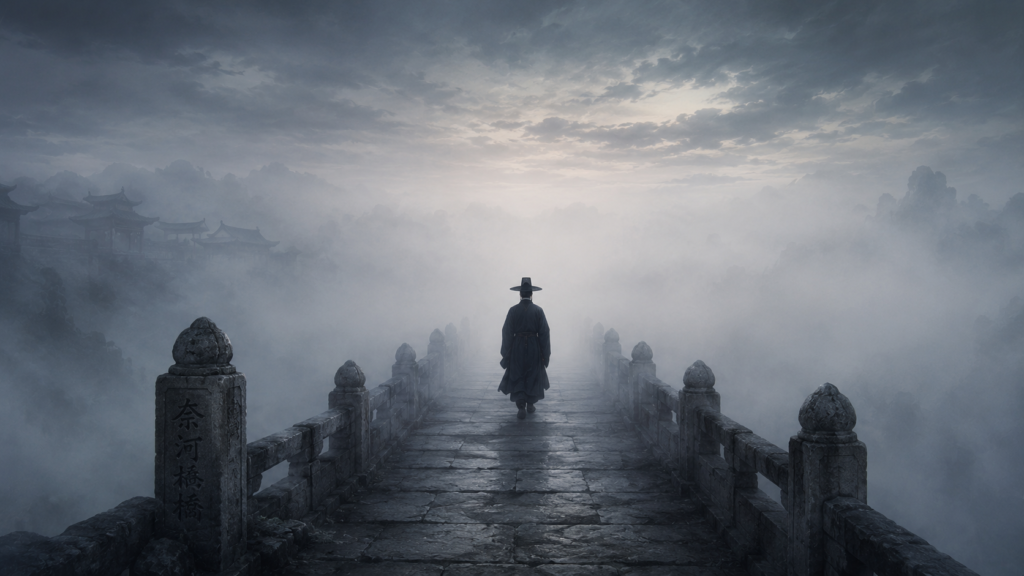
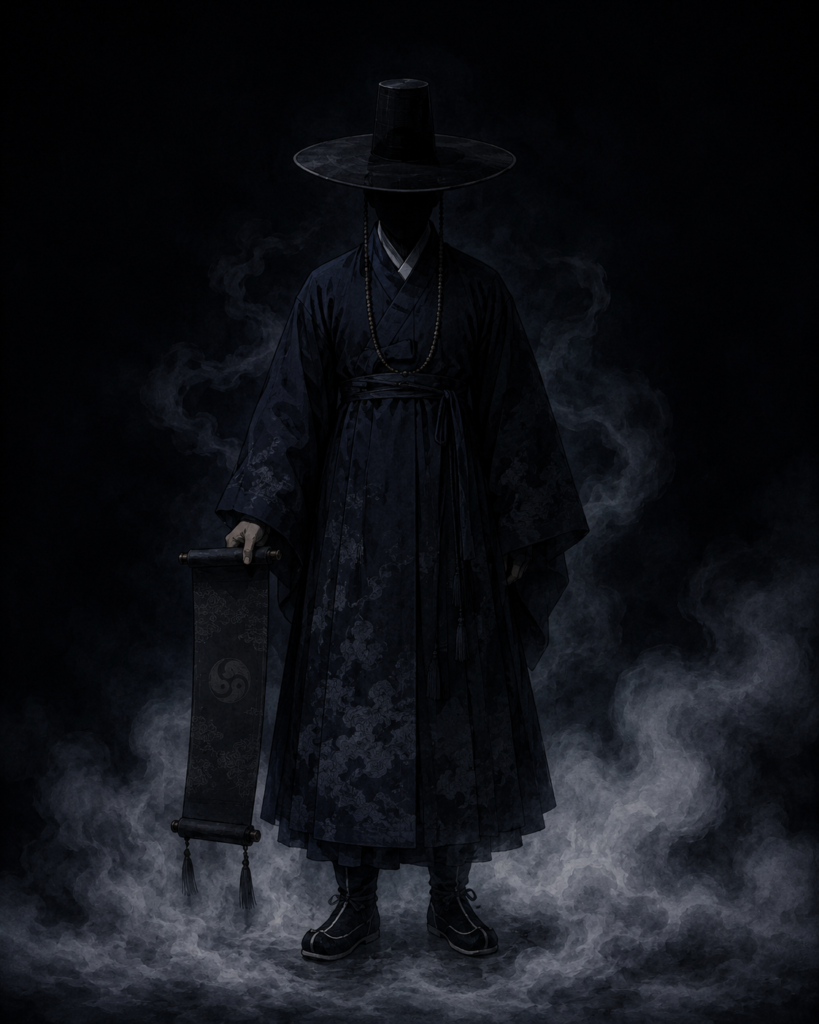
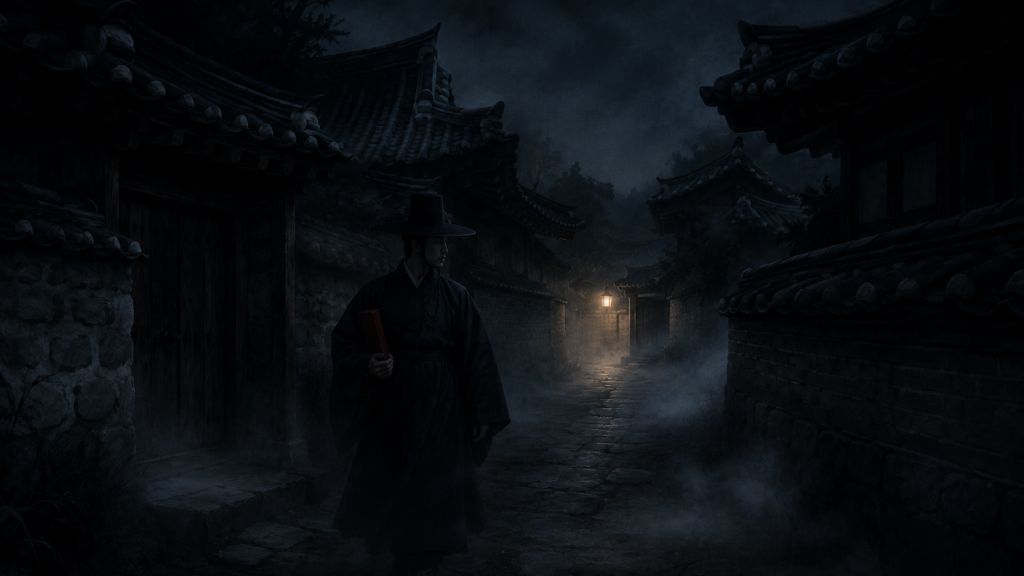
They are traditionally depicted wearing black hanbok (한복), Korea’s traditional garment, and a wide-brimmed black gat (갓) — the horsehair hat worn by Joseon-era civil servants and scholars. This is not a coincidence. The hat is the point. In Joseon society, that hat was the visual shorthand for authority: the mark of someone acting on behalf of a system larger than themselves.
They do not arrive with fangs or fury. They arrive looking like someone who came to deliver an order.
The Underworld Civil Servant: Death with Paperwork
Here is what makes the Jeoseung Saja genuinely different from anything in Western mythology.
They work within a system.
Think about what that actually means. Imagine you receive a knock at the door. It is not a monster. It is not a shadow creeping under your window. It is someone in a formal uniform, holding a clipboard, who says: “I have your name here. It is time.” That is the energy of the Jeoseung Saja. They are not chaos. They are procedure.
In Korean folklore, the Jeoseung Saja do not simply wander the earth claiming whoever they please. They are dispatched by the underworld — specifically by Yeomra (염라대왕), the King of the Dead — with a specific assignment. A name. A location. A time. They are sent the way a government official is sent: with a file, an order, and a job to complete.
They carry a myeongbu (명부), a death register: a record of every soul whose lifespan has reached its end. Their job is to confirm the name, locate the person, and escort them to the underworld. They do not choose who goes. They execute what has already been decided above them.
Think less like a monster attack. Think more like receiving a summons you cannot appeal.
The terrifying part is not the weapon. It is the paperwork.
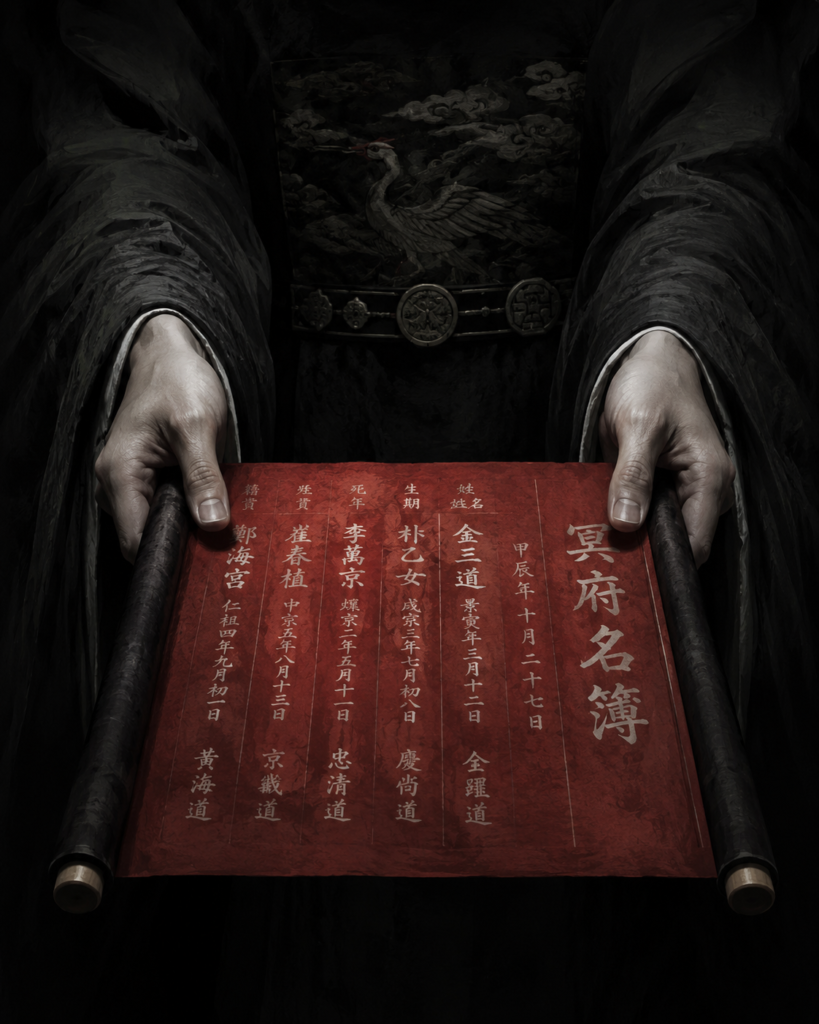
This image did not appear by accident. Korean society during the Joseon Dynasty (1392–1910) was built around an elaborate bureaucracy — government officials, magistrates, royal messengers, and layers of documents that controlled who could go where, do what, and owe what to whom. In that world, receiving an official notice was no small thing. A document with the right seal could overturn your life in a single afternoon.
Koreans mapped death onto that same familiar structure. And in doing so, they made death comprehensible — not comforting, not safe, but comprehensible. Death did not come from nowhere. It came from a system. With records. With procedure. With your name already on file.
In Korean folklore, death does not always arrive with a scythe. Sometimes, it arrives with a list.
Death Knows Your Name
There is a reason Koreans find the Jeoseung Saja more unsettling than a monster.
A monster can be wrong. It can miss. It can be tricked, fought, or avoided by chance.
The Jeoseung Saja arrive with your name already written down.
In Korean shamanic tradition — particularly in the myths of Jeju Island — the death messengers are described carrying a jeokpaeji (적패지), a document written on red paper with white ink, bearing the name of the soul they have come to collect. They read this name aloud as part of the ritual of claiming a soul.
This is where the association between the Jeoseung Saja and the calling of names comes from. It is connected especially to the legend of Gangnim Doryeong (강림도령), the most famous of all Korean death messengers — a figure whose story is very different from what you might expect. (More on them in Part 2.)
The fear is not just that death comes.
The fear is that death knows exactly who it came for.
There is something specific and cold about that. A natural disaster is indiscriminate. A disease is random. But a Jeoseung Saja who calls your name has made a selection. They looked at the list. Your name was there. They came.
This is why, in Korean folk tradition, offering food and gifts to a Jeoseung Saja was considered important — not to fight them, but to show respect. Offerings of shoes, food, and ritual objects were sometimes placed out during funerary rites, acknowledging that the dead must travel and that those who come to guide them should not be treated carelessly. You do not fight death’s envoys. You receive them with appropriate etiquette.
The scariest part is not that death has a weapon. It is that death has your name.
Can You Run Away from a Jeoseung Saja?
This is the question everyone eventually asks.
Korean folklore has stories — and they are genuine stories, not modern inventions — in which people manage to outwit or delay the Jeoseung Saja. A man hides when the messengers come. A clever trick confuses them. A case of mistaken identity sends them to the wrong person.
There are even stories where a Jeoseung Saja accidentally takes the soul of someone with the same name — a cosmic clerical error that causes chaos in the afterlife until the mistake is corrected. This kind of story says something interesting: even the afterlife’s administration is not perfect. The messengers can be confused. The records can occasionally be wrong.
But here is the important distinction, and Korean folklore is very clear about it:
Running away from a Jeoseung Saja is like avoiding the officer, not erasing the warrant.
They can be delayed. They can be momentarily confused. But the list exists. If your name is on it, the system that produced it does not disappear because you hid from the ones who came to deliver it.
The messenger can be avoided. The list cannot.
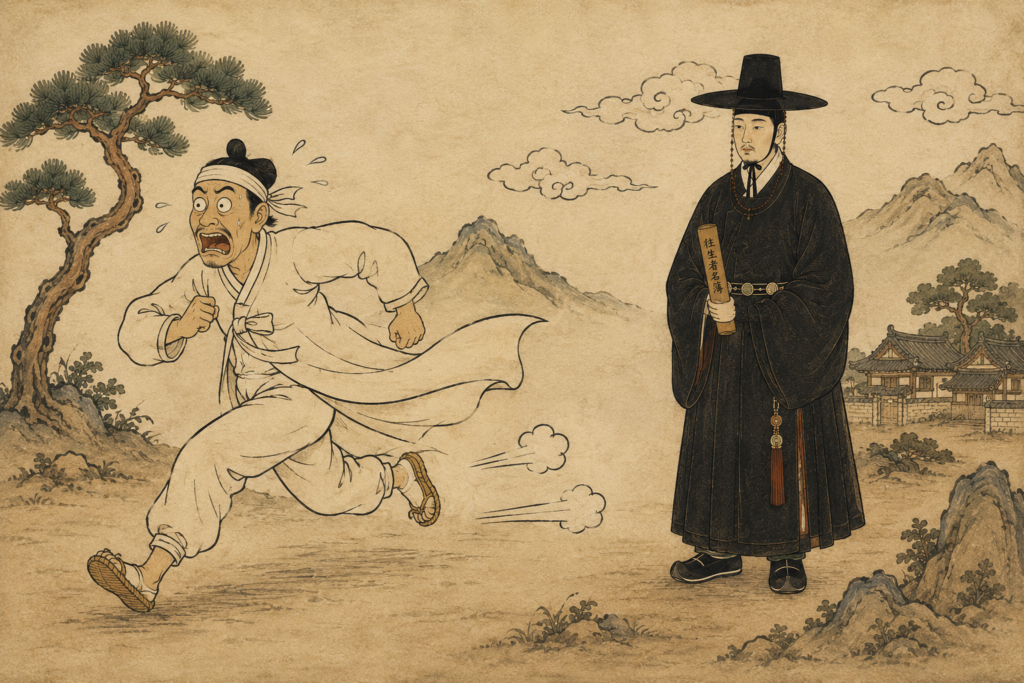
This is why stories of escaping the Jeoseung Saja never quite end in permanent freedom. They end in extension, in borrowed time, in cosmic readjustment. The man who tricked the messengers eventually dies anyway. The soul sent by mistake is returned. The system reasserts itself.
Because the Jeoseung Saja are not the danger. They are the consequence of a decision already made somewhere above them.
Frightening, But Strangely Human
The Jeoseung Saja are frightening. But they are not evil.
This is something that takes a moment to sit with. In a lot of Western storytelling, isn’t the line between “agent of death” and “evil being” almost automatic? If something shows up to end your life, the instinct is to see it as your enemy. The monster. The villain.
Korean folklore draws a different line.
The Jeoseung Saja are frightening not because they are cruel or malevolent. They are frightening because they are calm, official, and already certain. They do not need to argue with you. They do not need to chase you. They arrived knowing the outcome. That certainty is what makes them terrifying.
But the same folklore that makes them fearsome also makes them curiously human.
They can be confused by clever tricks. They can feel awkward when well-fed. Some stories show them accepting a meal from a family before taking someone — adding a strange, domestic quality to death itself.
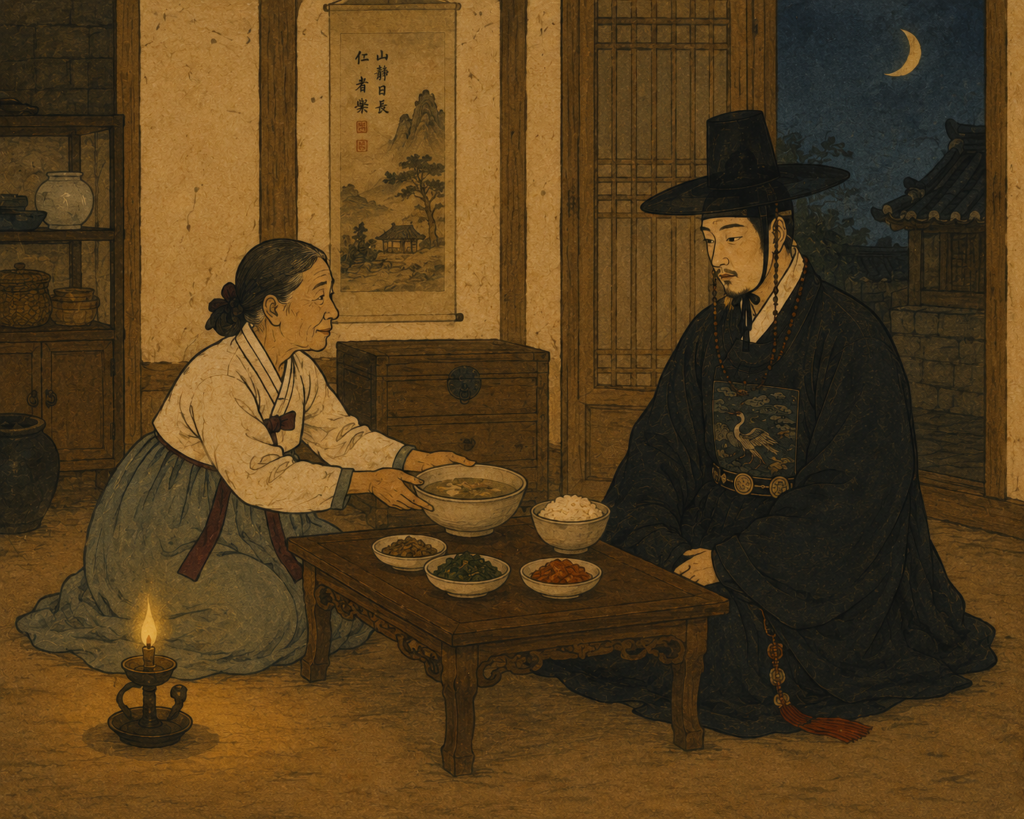
They are not demons burning with hatred. They are functionaries doing a job they did not choose, operating within a system that existed long before they arrived and will continue long after they leave.
The image of the Jeoseung Saja in Korean popular culture today — the black fedora, the long coat, the weary and melancholic face — is largely a modern refinement of a much older image. The traditional black gat became the fedora. The black dopo (도포) became the long coat. The bureaucratic messenger became the tragic immortal. The costume changed. The core did not.
They arrive in uniform, carrying a record. They do not hate you. They simply know.
The List, and What Comes Next
In the end, the Jeoseung Saja are frightening not because they are monsters, but because they are certain.
They do not need to chase you forever. They only need your name to remain on the list.
And in Korea’s most famous story of the death messengers, the greatest Saja of all was not born as a spirit. They began as a human being — a mortal government official named Gangnim, who was given an impossible task, traveled into the underworld itself, and returned changed forever.
His story is where the mythology of the Jeoseung Saja truly comes alive.