What Is a Mudang? Inside Korea’s Ancient Shamanic World
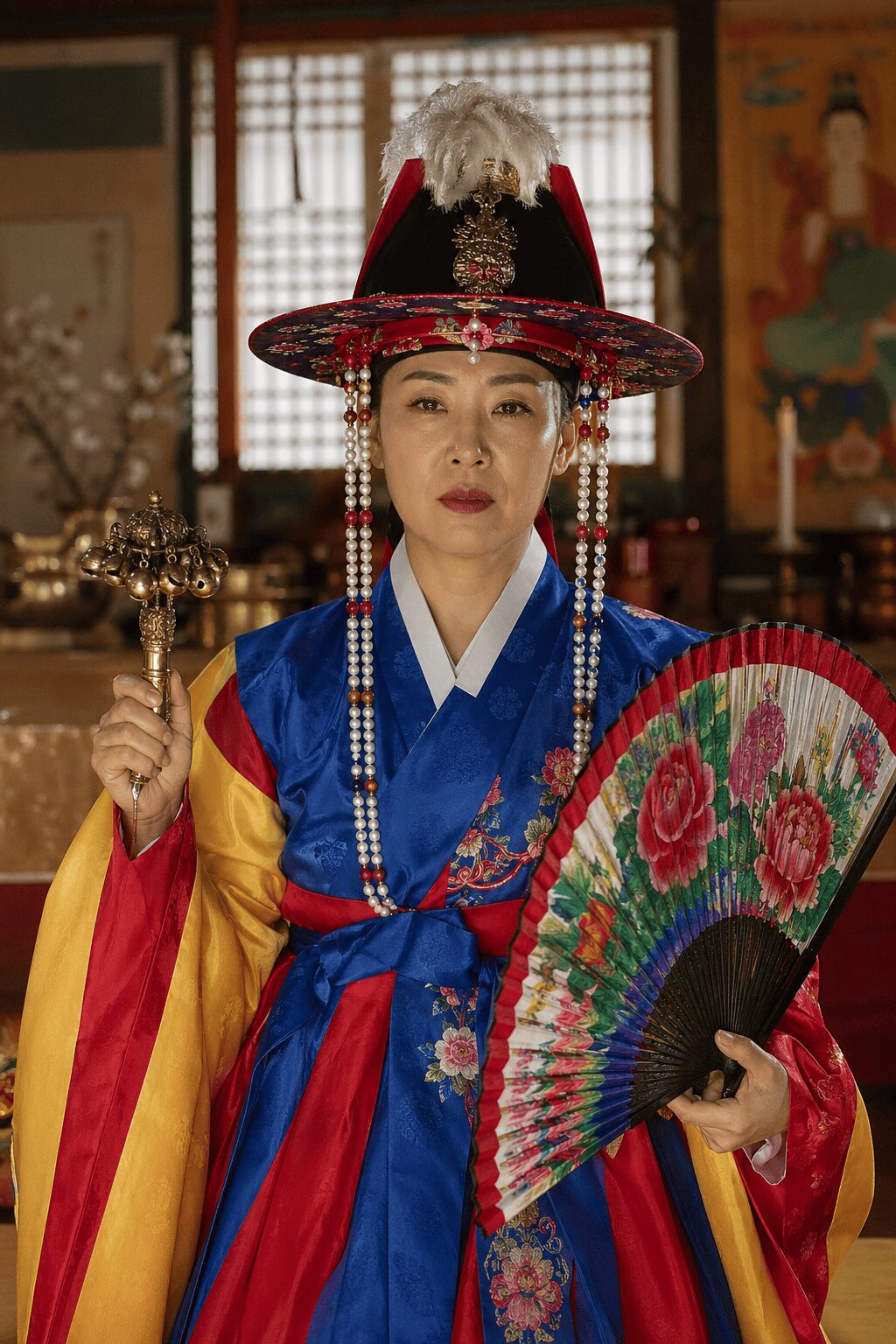
Maybe you’ve seen one in a K-drama. Vivid silk robes. A bell in one hand, a fan in the other. Eyes rolled back like she’s tuned into a frequency the rest of us can’t hear. And you thought: shaman. Like the ones in movies.
Here’s the thing — Korea’s mudang is one of the most misunderstood figures in all of Korean culture. And the gap between what people imagine and what a mudang actually is? It’s enormous.
I grew up in Korea. I’ve seen mudangs on TV, heard about them from relatives, walked past their shrines tucked between convenience stores and apartment buildings. And even I had to unlearn a lot of what I thought I knew. So if you’re coming to this as a complete outsider, don’t worry — we’re starting from zero.
What is a mudang? What do they actually do? And why has this tradition survived thousands of years of suppression, war, and modernization?
That’s what this article is about. Korean shamanism, mudang culture, and the world most people never see.
More Than a Fortune Teller
Calling a mudang a fortune teller is like calling a surgeon “someone who uses knives.” Technically, you’re not wrong. But you’ve missed the entire point.
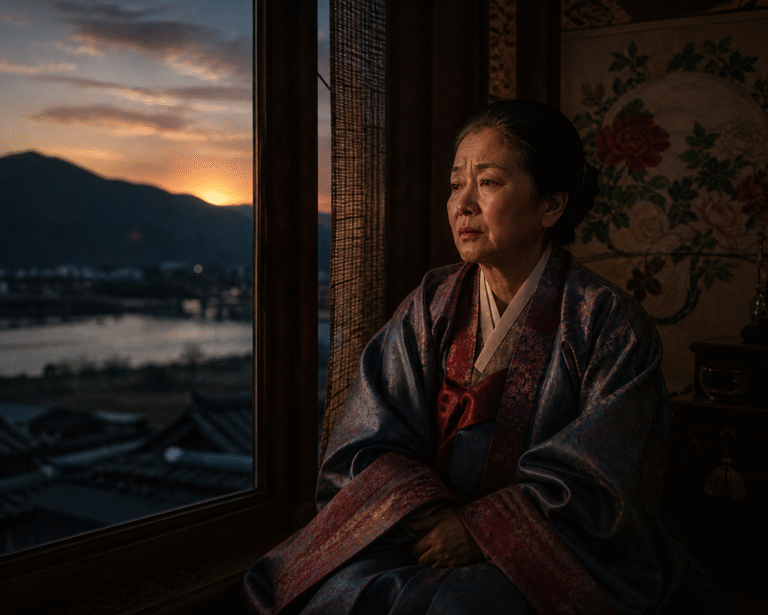
The word mudang (무당) is pure Korean — no Chinese roots, no borrowed meaning. It refers to a female spiritual practitioner who receives a deity into her body and performs rituals on behalf of the living and the dead. Her male counterpart is called a baksoo (박수), though in everyday speech, most Koreans just say mudang for both.
At her core, a mudang is a bridge. Between the world you can see and the world you can’t. Between a family’s grief and the spirit that might be causing it. When bad luck hits a Korean household — illness, business failure, a string of accidents that feels too specific to be coincidence — one of the oldest instincts in this culture is to ask: is someone on the other side trying to tell us something?
That’s where the mudang comes in.
Her role was never just personal. Historically, the mudang was the ritual center of her entire village — the one who prayed for good harvests, sent off the dead so their spirits wouldn’t linger in pain, and mediated between the human world and the realm of gods and ancestors. In ancient Korea, the line between spiritual leader and political leader barely existed. Some historians believe that chacha-woong (차차웅), one of the earliest royal titles in the Silla kingdom, actually meant “mudang.” The ruler and the shaman were, quite literally, the same person.
That kind of power didn’t last. But the mudang did.
Key Takeaway: A mudang is not a fortune teller or a performer. She is — and has been for thousands of years — a spiritual intermediary between the living and the dead, rooted in one of the world’s oldest continuous shamanic traditions.
What Happens at a Gut?
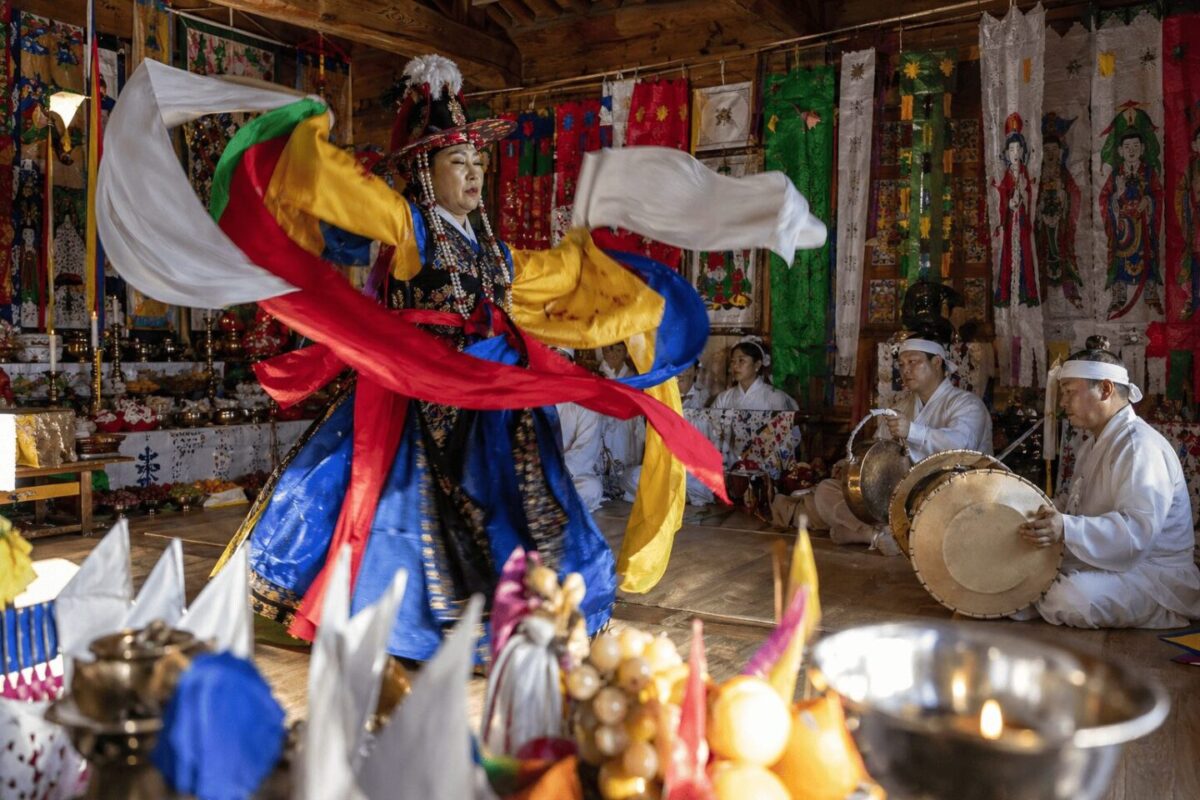
The mudang’s central ritual is called a gut (굿). And if you’ve never seen one, I’ll be honest with you: nothing I write here will fully prepare you.
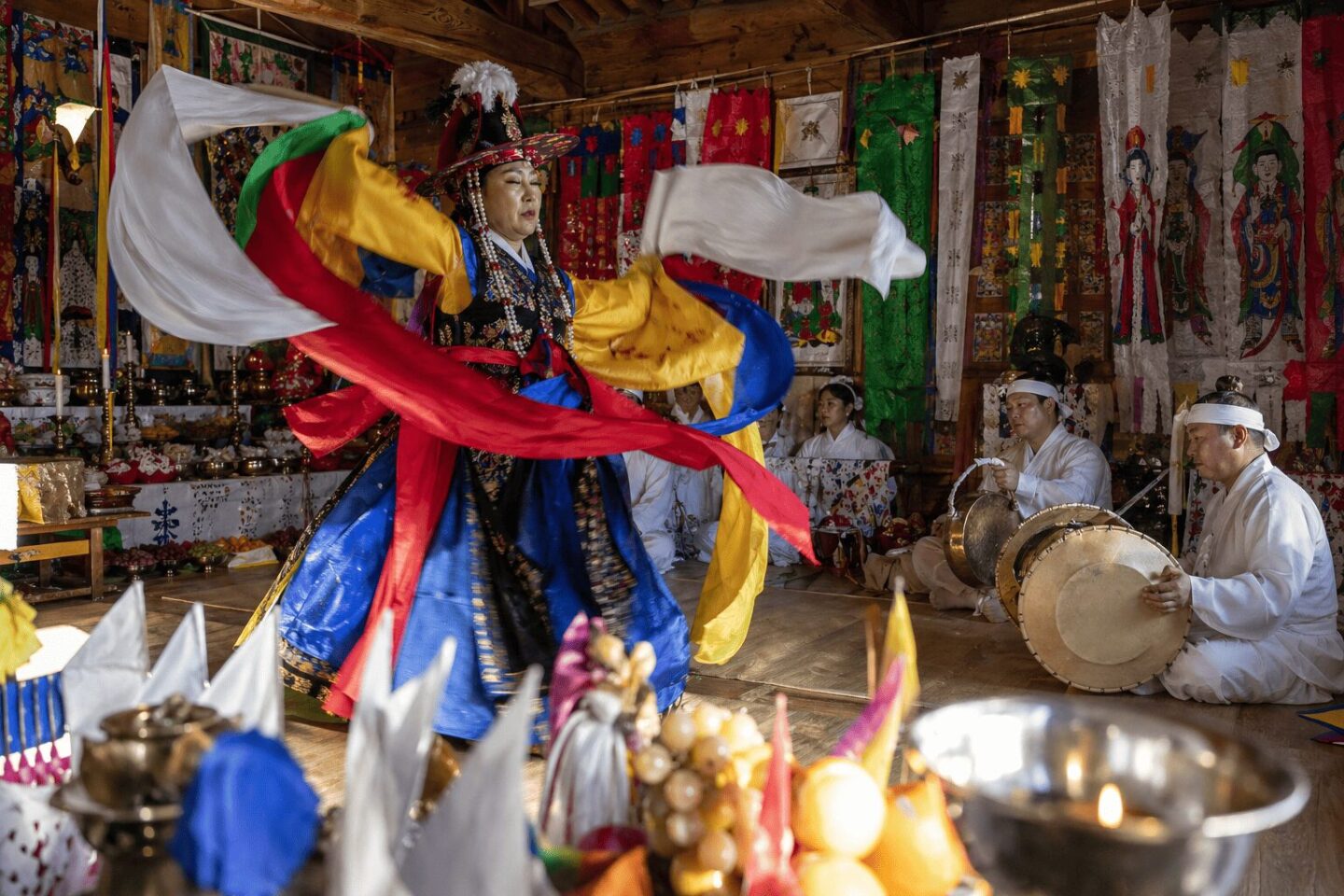
A gut is loud. It’s colorful. It can last for hours — sometimes an entire day and night without stopping. There are drums, cymbals, haunting melodies on traditional instruments, and the mudang herself dancing in layered silk robes — red, blue, yellow, white — each color calling a different deity.
But a gut is not a performance for an audience. It’s a negotiation.
The mudang invites specific gods and spirits into the space. She entertains them (yes — Korean spirits apparently appreciate a good show). She delivers their messages to the family. She speaks for the dead. She might shift into a completely different voice mid-ritual when a spirit enters her. She might weep, or laugh, or say something about a deceased family member that no one told her — something that makes everyone in the room go very, very quiet.
The rituals vary dramatically by region. In Seoul and the north, mudangs dance with swords and flags in dramatic, almost theatrical sequences. In Chungcheong province, the ritual is the opposite — the practitioner sits still and chants for hours in a style so restrained it barely looks like shamanism. In Jeju Island, the shaman is called a simhang (심방) and works within an entirely different cosmological system.
And then there’s jakdu (작두).
Standing barefoot on the blade of a large knife. Not a trick. Not a prop. The mudang climbs onto the blade to prove that the deity has fully entered her body — that she is protected. If the spirit is truly present, she doesn’t bleed.
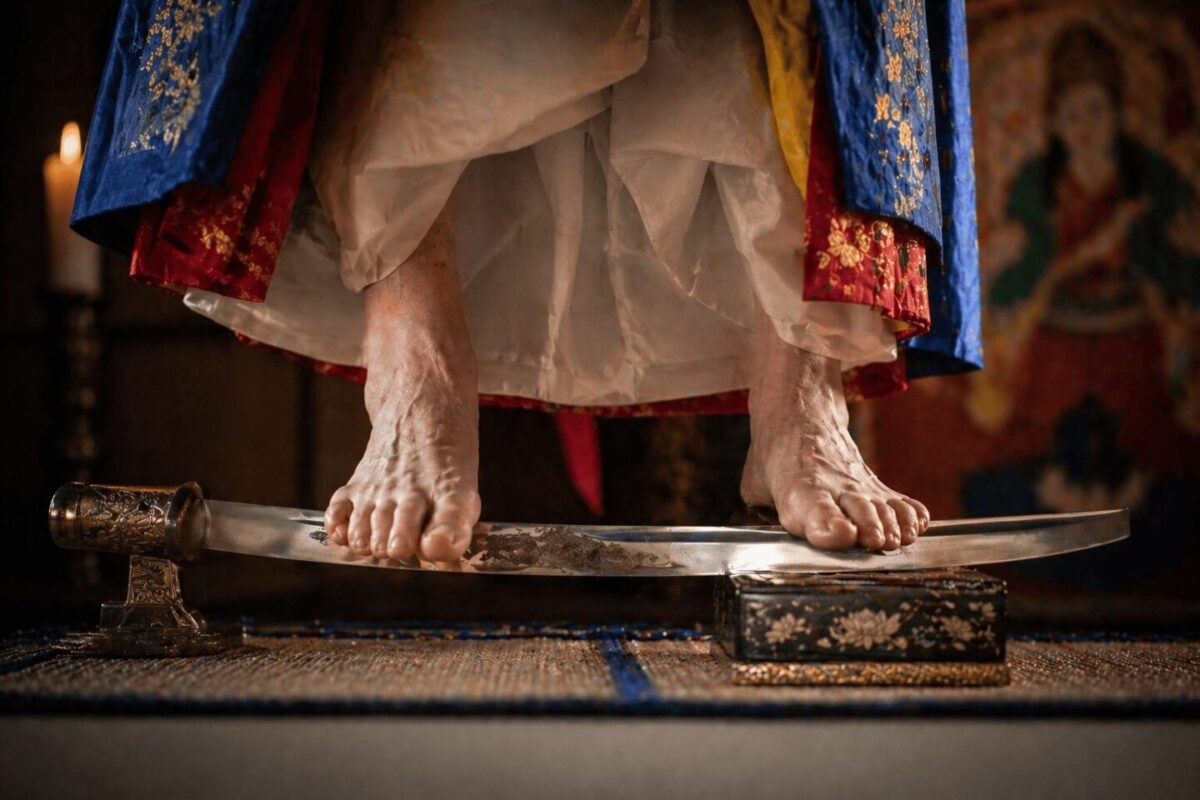
I’ve seen footage of this. Even knowing there’s a cultural and spiritual logic behind it, even approaching it intellectually — it stops you cold.
Key Takeaway: A gut is not a performance for entertainment. It’s a spiritual negotiation — between a family’s need and the spirit world — conducted through music, dance, trance, and sometimes, things that are very hard to explain.
From Palace to Outcast — and Back?
Here is a history that most Koreans know somewhere in the back of their minds — but rarely say out loud. And that almost no foreigner knows at all.
For most of Korean history, the mudang was respected. Through the ancient tribal confederacies, through the Three Kingdoms period, through the Goryeo dynasty — shamanic festivals were national events. Yeonggo in Buyeo, Dongmaeng in Goguryeo. The spiritual and the political were one.
Then came the Joseon dynasty (1392–1897).
Neo-Confucianism became state ideology, and Confucian scholars had zero tolerance for what they saw as superstition. The mudang was pushed to the very bottom of Korean society — classified in the palcheon (팔천), the eight lowest social categories, alongside servants and outcasts. She was taxed specifically because she was a mudang — not as recognition, but as punishment dressed up in bureaucratic language.
She was driven out of cities. Banned from the upper classes.
And yet — she never disappeared. Because people still needed her. The Confucian scholars scoffed in public. Many of them went to mudangs in private. That contradiction — official rejection, quiet reliance — has defined the mudang’s position in Korean society for centuries. And honestly? It still does.
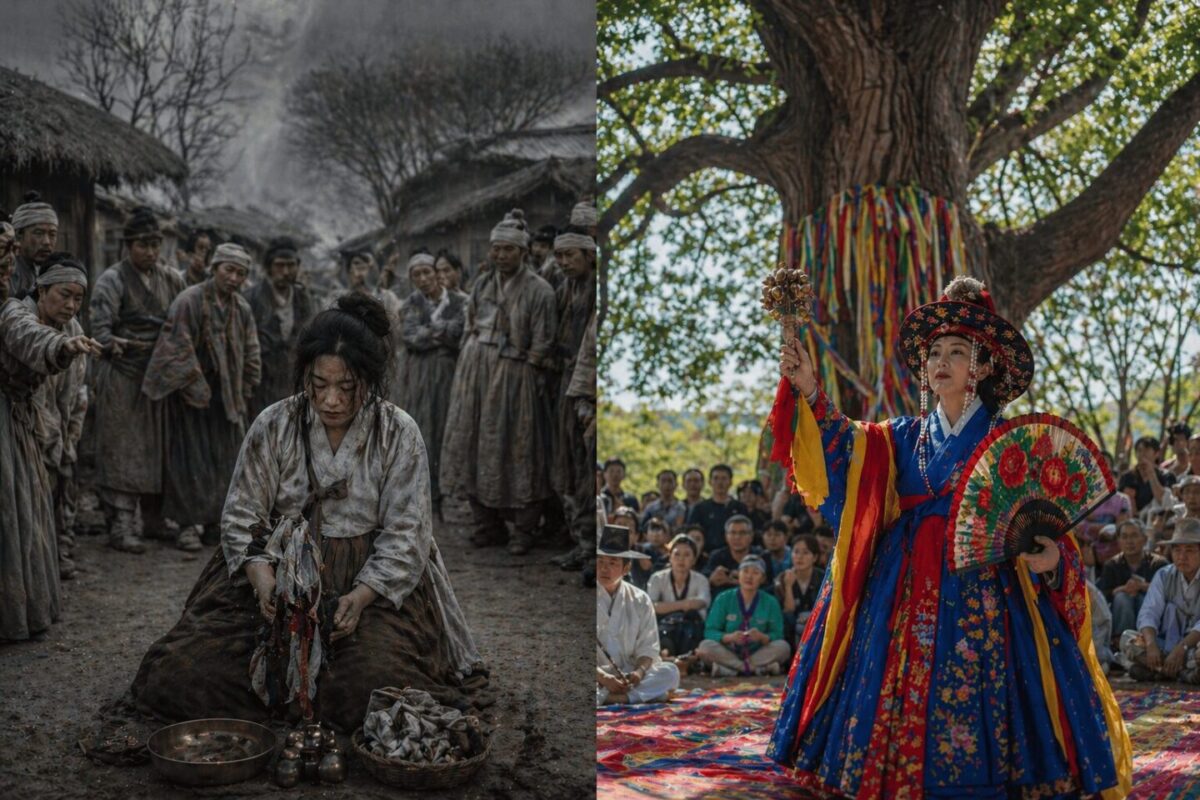
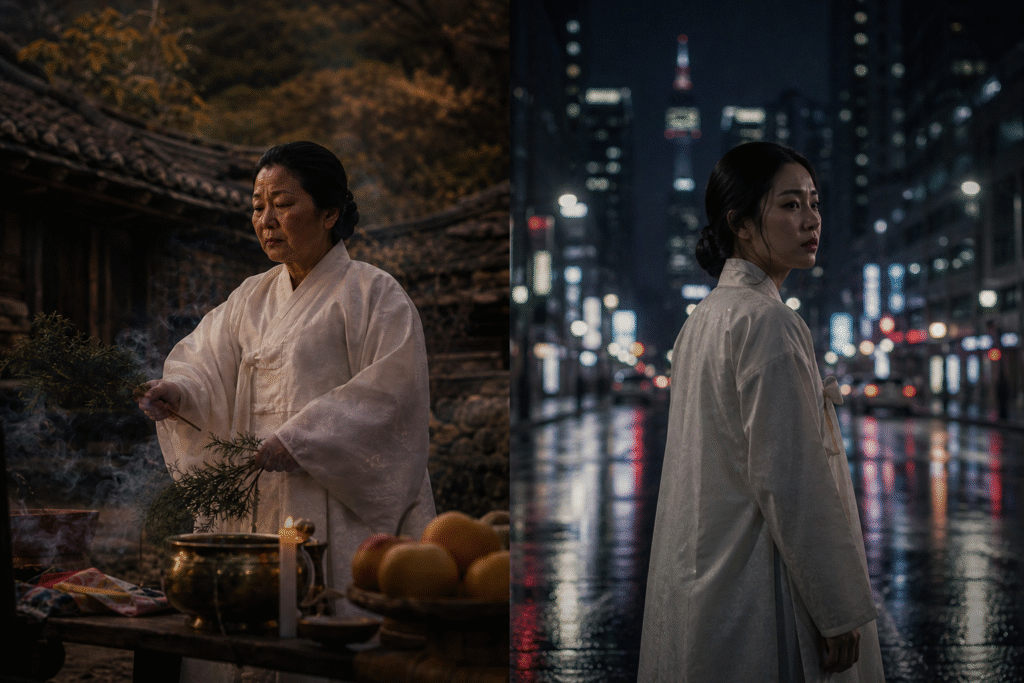
Today, the mudang lives in a strange in-between space. Legally, she is not a religious figure. She’s classified as a “divination-related service worker” and pays income tax like anyone else — no exemptions, unlike Buddhist monks or Christian pastors. And yet, some mudangs are recognized as living national cultural treasures. The Gangneung Dano Festival and Jeju Chilmeoridang Yeongdeunggut are UNESCO Intangible Cultural Heritage. Government-funded. Internationally celebrated.
A superstition and a national treasure. At the same time. Only in Korea.
Key Takeaway: The mudang went from being the spiritual center of Korean society to its lowest outcast — and is now simultaneously a taxed “service worker” and a UNESCO-recognized cultural treasure. That contradiction says everything about Korea’s complicated relationship with its own past.
Born Into It or Called By It
Not all mudangs are the same. And this is where it gets genuinely fascinating — because there are two completely different types, with almost opposite relationships to the spirit world.
The first is the seseupmu (세습무) — the hereditary shaman.
Think of her like a village priest whose position has been passed down through generations. No divine possession required. She learns through years of observation and practice — mastering the songs, dances, and ritual forms specific to her region. She’s less a vessel for spirits and more a custodian of tradition. A living archive.
If you’ve watched Netflix’s KPop Demon Hunters, you might actually have a feel for this. Rumi, Mira, and Zoey don’t choose their mission — it finds them, carried forward through generations of women who came before. The specifics are different, but that sense of inherited duty, of a calling that runs in the bloodline? That’s closer to the seseupmu than anything else in popular culture right now.
The second is the gangshinmu (강신무) — the possession shaman.
This is the type most people picture. She didn’t inherit the role. She was chosen — usually against her will — through a process that begins with an illness no doctor can name or cure.
That illness is called sinbyeong (신병). The spirit sickness. And it’s the subject of our next article.
What’s worth noting here is that these two types coexist, sometimes collaborate, and often misunderstand each other. The seseupmu carries cultural legitimacy and deep regional roots. The gangshinmu carries raw spiritual intensity and the ability to adapt. In modern Korea, where traditional village communities have largely dissolved, the gangshinmu has become the dominant type — more visible, more accessible, more suited to urban life.
The seseupmu, meanwhile, is quietly fading. Kept alive mostly by cultural preservation programs and the rare individual who chooses to carry a tradition forward even when the community it was built to serve no longer exists.
Not Quite a Shaman — Korea’s Mudang Is Something Else
Shamanism exists across the world. Siberia. Mongolia. Indigenous communities in the Americas. Parts of Africa and Southeast Asia. And yes — there are genuine similarities. Trance states. The spirit world. The role of go-between.
But Korea’s mudang has traveled her own road for thousands of years, absorbing everything she encountered — Buddhism, Taoism, Confucianism, even Christianity — and making it her own.
Korean mudangs have been known to enshrine Jesus alongside traditional Korean deities. There’s a documented account of a missionary who converted a mudang — only to return the next day and find her conducting a gut with his portrait of Jesus as one of the honored spirits on the altar. The mudang saw no contradiction in this. Her tradition has always been about serving the needs of the living and the dead, in whatever form that requires.
She is practical in a way that organized religion rarely allows itself to be.
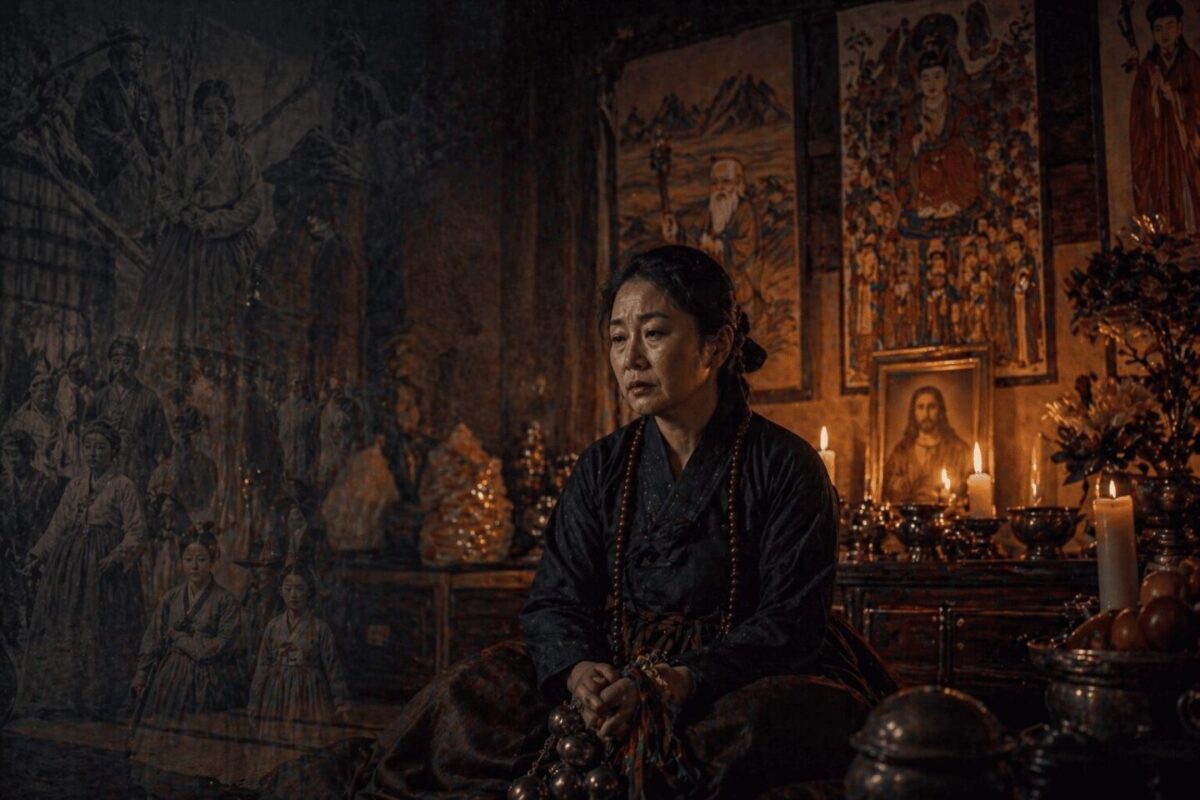
She also carries something no other shamanic tradition quite replicates: the specific emotional weight of Korean history. The grief of a people who have survived invasion, occupation, war, famine, and one of the most violent economic transformations in modern history — all of it is embedded in her rituals. A gut is not just a spiritual ceremony. In a very real sense, it is an act of cultural survival.
And this, I think, is what makes the mudang so hard to dismiss — even for people who don’t believe a word of it. She holds something that Korea has never been able to fully throw away, no matter how hard it tried.
Which leads us to the part of this story that most people — even Koreans — don’t fully understand.
What happens when the spirits choose someone who doesn’t want to be chosen? What does it cost to say no?
That’s Part 2. And it is not a comfortable story.