Why Are There So Many Kims in Korea? A Korean Explains a Very Literal Proverb

Why are there so many Kims in Korea? It’s one of those questions that people notice long before they ever look up the answer — usually somewhere between watching a K-drama and wondering how three different characters ended up with the same last name.
Ask someone who grew up here, though, and you’ll probably get a joke before you get a fact.
Before everyone carried a phone in their pocket, Korean coffee shops — dabang — ran on a different system. If you were expecting a call, you didn’t wait by your own phone. You gave out the dabang’s number instead, and when the call came in, an employee would walk through the room and shout out your name.
My parents’ generation loved joking about one particular version of this. If the employee called out, “Is Mr. Kim here? A call for Mr. Kim!” — half the room would turn around.
It’s an exaggeration, obviously. Nobody was actually counting heads in a coffee shop. But the joke lands because of something that’s genuinely true: enough Koreans are named Kim that shouting for one, in a room full of strangers, is a spectacularly bad way to find a specific person.
Let’s start with the number the old joke was exaggerating.
The Real Number Behind the Joke
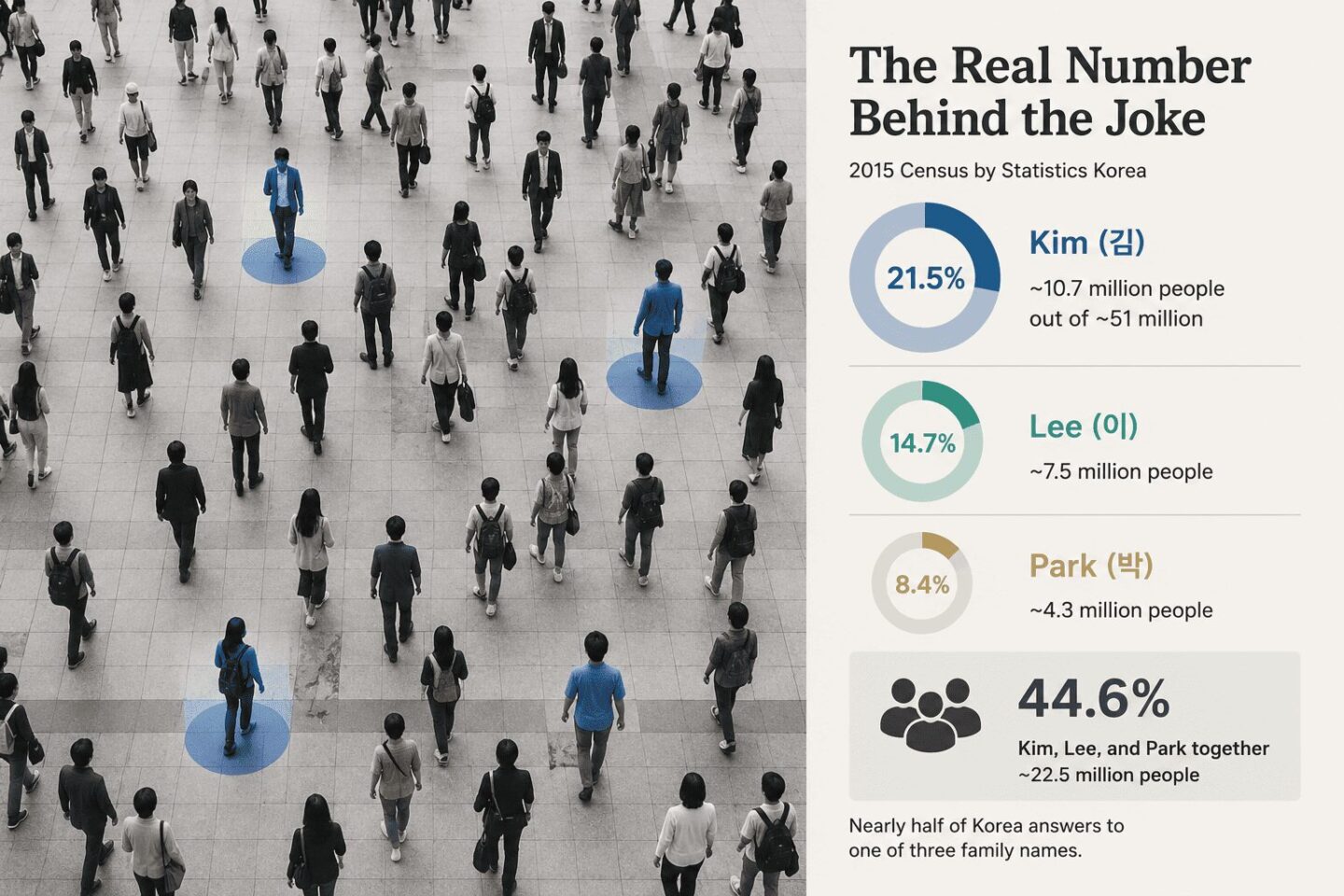
According to Statistics Korea’s 2015 population census — the most recent full national count of surnames — Kim (김) belongs to roughly 21.5% of the population: just under 10.7 million people out of about 51 million. That’s not literally half a room. But it is one in five. Stand in any group of five Koreans and, statistically, one of them is a Kim.
Add Lee (이) at 14.7% and Park (박) at 8.4%, and these three surnames alone cover nearly 45% of the entire country — close to half of Korea answers to one of three family names.
No wonder the coffee shop joke never needed footnotes to land.
The Proverb: Looking for Mr. Kim in Seoul
This exact problem is baked into a Korean proverb: 서울 가서 김서방 찾기 (Seoul gaseo Kim-seobang chatgi) — literally, “going to Seoul and looking for Mr. Kim.”
It describes searching for someone with no address, no real details, nothing but a name — and a hopelessly common one at that. It’s Korea’s version of “a needle in a haystack,” but the mechanics are almost the opposite. In English, you’re hunting for one small object lost in an enormous pile. In Korean, you’re hunting for one specific person inside a sea of people who happen to share his exact family name. The size of the haystack isn’t the problem — the fact that everything in it looks the same is.
And the proverb didn’t pick “Kim” by accident. Of every surname it could have used, it reached for the one most likely to turn a simple search into an impossible one.
(There’s actually a mirror-image version of this saying — 서울 김 서방 집도 찾아간다 — which claims the opposite: that if you try hard enough, you can find anyone, no matter how little you have to go on. Korean proverbs are perfectly happy contradicting themselves depending on the point someone’s trying to make. But in everyday conversation, it’s the hopeless version — the one this article is about — that people actually reach for.)
Why Are There So Many Kims in Korea, Really?
Two historical threads are usually pointed to.
The older one traces back to the ancient kingdoms. Silla, one of ancient Korea’s three major kingdoms, had a royal Kim line that traces its legendary origin to Kim Alji. A separate Kim lineage descends from King Suro, founder of Gaya, another ancient Korean kingdom that existed alongside Silla on the southern peninsula. Both lines carried the name forward for well over a thousand years, through nobility, through war, through dynastic change — which alone would have given Kim a significant head start over most other surnames.
The second thread is more recent and, honestly, more human. For most of Korean history, surnames weren’t universal — many commoners simply didn’t have one. That changed permanently after Korea’s late Joseon and Gabo-era reforms opened surname registration to the entire population. Historians generally agree that when ordinary families finally registered names of their own, a large number gravitated toward Korea’s most established and prestigious surnames rather than starting something new from scratch. Kim, already the biggest name in the country, only grew from there.
Put those two threads together — a thousand-plus years of dynastic head start, followed by a wave of newly-registered families choosing the safest, most recognizable option — and the answer to why are there so many Kims in Korea stops looking like a coincidence and starts looking like simple math.

Some Things Never Change
The dabang are mostly gone now. But the underlying math hasn’t gone anywhere — it just moved venues. Shout “Kim Min-jun!” on a crowded subway platform today, and you can still expect more than one head to turn. Post it in a group KakaoTalk chat with people you don’t know well, and there’s a real chance two of them share the exact same name. (And if you type it out on KakaoTalk, you might even catch yourself adding a cheerful ~ to soften the sentence — that’s a whole other Korean quirk that doesn’t survive translation either.)
The joke my parents told wasn’t really about a coffee shop. It was about a country where, statistically, you’re never more than a few strangers away from another Kim — and where an entire proverb exists just to complain about it. If you’re still wondering why are there so many Kims in Korea the next time you’re watching a K-drama full of them, now you know it’s not your imagination.