Can a South Korean Understand a North Korean? A Korean Answers
It’s one of the most common questions people ask about Korea. After more than seventy years of total separation — different governments, different schools, a sealed border almost no one crosses — do the two Koreas still speak the same language? If a South Korean and a North Korean sat down across a table, could they actually understand each other?
So — can a South Korean understand a North Korean? Let me give you the short answer first, as a South Korean: yes. Easily. The differences are real, but they’re the kind you notice, not the kind that stop a conversation.
The longer answer is more interesting — because how they’re different says a lot about what the last seventy years did to one language pulled in two directions.
Same Language, Not Two Languages
The first thing to clear up is the biggest misconception. North Korean and South Korean are not two different languages. They are not even as far apart as, say, British English and American English feel to some people. They are the same language, full stop — with regional and historical differences sitting on top.
The closest honest comparison is dialect. Korea has always had rich regional dialects — the speech of Gyeongsang Province in the southeast, Jeolla in the southwest, Gangwon in the east, and Jeju Island, which is so distinct it can be genuinely hard for mainlanders to follow. Against that backdrop, North Korean speech registers to a South Korean ear as simply another regional variety. A noticeable one. But not a wall.
When I hear North Korean speech in the media — defector interviews, North Korean news broadcasts — I can follow it without any real trouble. Something sounds different, yes. But I’m never lost. It’s the feeling of this person is from somewhere else, not I can’t understand this person.
So when people reach for comparisons like Spanish and Portuguese — two languages where speakers can roughly guess each other’s meaning — that actually overstates the distance. North and South Korean are much closer than that. It’s one language, wearing two slightly different coats.
If you’re curious how much hidden meaning Korean packs into the smallest marks, here’s another example : [What Does ~~~ Mean in Korean?]
The Most Famous Difference: Foreign Words
If there’s one place the two Koreas split most visibly, it’s in how they handle words borrowed from other languages.
South Korea absorbs foreign words directly. An ice cream is aiseukeurim — the English word, Koreanized in sound. A computer is keompyuteo. A bus is beoseu. Decades of openness to English especially have poured thousands of these loanwords straight into everyday South Korean speech.
North Korea went the opposite way. Instead of borrowing the foreign word, it builds a new one out of native Korean roots. The example South Korean textbooks always reach for: ice cream in North Korea is supposedly eoreum-bosungi — literally something close to “fluffy ice.” A homegrown description instead of a borrowed sound.
But here’s where I have to be honest with you, as a Korean — because this is exactly the kind of thing that gets distorted.
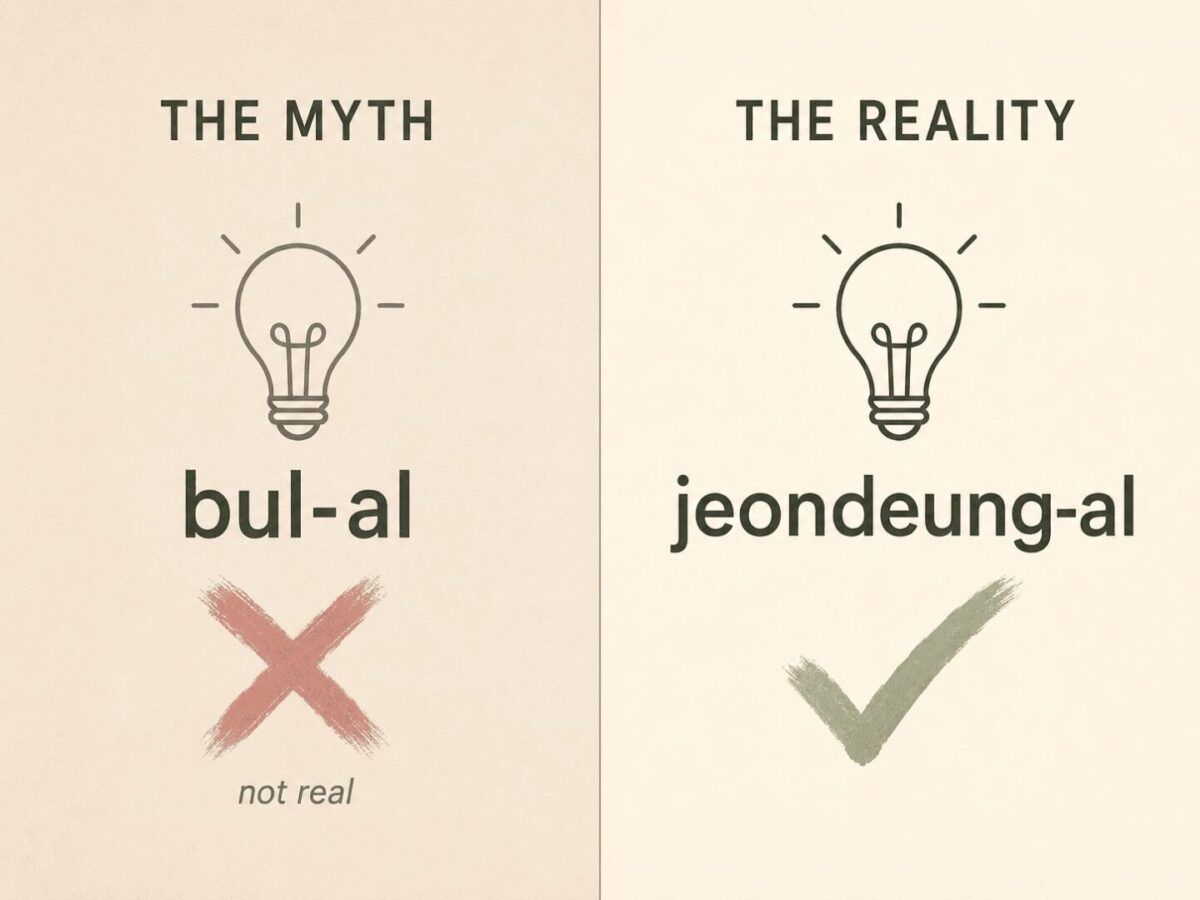
A lot of what South Koreans “know” about North Korean vocabulary is exaggerated, and some of it is simply made up. For decades, funny lists of supposed North Korean words circulated in the South — and many of them were never real North Korean words at all. The most infamous example: the claim that North Koreans call a light bulb bul-al (a crude, giggle-inducing word). It spread everywhere. It is false. North Koreans say jeondeung-al or jeongi-al — perfectly ordinary terms. The light bulb joke was someone’s invention that hardened into “fact.”
Even eoreum-bosungi, the textbook ice cream example, is shakier than it looks. Language researchers point out it was a “purified” word entered into a dictionary rather than something North Koreans actually say day to day — many just use a loanword too.
So the real picture is subtler than the popular one. Yes, the North genuinely leans toward native-Korean coinages where the South borrows. But the size of the gap has been inflated for entertainment, and sometimes to make the other side sound stranger than it is. The actual everyday vocabulary overlaps far more than those viral word-lists suggest.
The Thing You Can’t Hide: Accent
Here’s where it gets human.
Vocabulary, you can learn. A North Korean who moves to South Korea can pick up aiseukeurim in an afternoon and swap it in for eoreum-bosungi. Words are easy to trade out.
Accent is not.
Ask any South Korean and they’ll tell you the same thing: you can almost always hear it. The intonation, the rhythm, the particular melody of North Korean speech carries through even when the words have been swapped out. A North Korean defector can learn every South Korean term perfectly and still, the moment they speak, a South Korean ear catches it — ah, they’re from the North.
This is why, in the stories you hear, it’s rarely the vocabulary that trips people up. Meaning gets across. It’s the accent that marks where someone is from, the way a strong regional accent does anywhere in the world. It’s the hardest layer to shed, because it was set long before anyone decided to move.
Why North Korean Sounds “Old-Fashioned”
There’s a quality South Koreans often notice in North Korean speech: it can sound stiff, formal, even a little old-fashioned — like Korean from an earlier era.
There’s a real reason for that, and it has nothing to do with anyone speaking “wrong.”
Over the last seventy years, South Korean has changed at breakneck speed. Waves of English loanwords, internet slang, new coinages, pop-culture phrases, constant contact with the outside world — the language has been churning and reinventing itself nonstop. North Korean didn’t go through that. Cut off from those currents, it kept much more of its older shape.
In a sense, North Korean is something like a language time capsule. It’s not frozen exactly — it has its own new words, its own evolution — but it skipped the specific tidal wave of foreign influence and rapid modernization that reshaped the South. So to a South Korean, it can feel like hearing a more “classic” version of Korean — the same language, on a slower clock.
Can a South Korean Understand a North Korean After Reunification?
People sometimes assume that after such a long separation, the language gap would be a serious obstacle to reunification. As a South Korean, I don’t really see it that way.
If anything, language might be one of the first things to smooth out.
Koreans are already completely used to dialects. We grow up surrounded by them — Gyeongsang, Jeolla, Gangwon, Chungcheong, Jeju. We’re constantly adjusting our ears to different regional speech, and nobody thinks of those differences as barriers. They’re just part of the texture of being Korean. North Korean speech would fold into that same category — one more dialect, more distinct than most, but a dialect all the same.

I genuinely don’t believe the two Koreas stay apart because of language. Whatever keeps the peninsula divided, it isn’t the inability to understand each other’s words. Put a South Korean and a North Korean in a room and they will talk. They might pause on a word here and there. They’ll hear the accent immediately. But they’ll understand each other — because underneath everything, it was always one language.
A Note Before You Go
So — can a South Korean understand a North Korean?
Yes. Not “sort of,” not “with effort.” Yes. The two have spent seventy years apart, and that time left its marks: different words for foreign things, an accent that gives you away, a flavor that sounds like Korean from a slightly older world. But the marks sit on the surface. The language underneath is shared.
It’s the same Korean, split into two versions that have been living on different clocks. And if those clocks ever sync back up, the words will be the easy part.






Интересная статья, спасибо за информацию!