Imugi: The Korean Serpent That Almost Became a Dragon

Every mythology has its dragons. Korea has something better: the dragon that didn’t make it.
I first met the imugi in a children’s picture book, the way most Koreans do. I must have been six or seven. And I remember, even then, feeling that the ending was somehow unfair — that this creature had been robbed. If you grew up outside Korea, you’ve probably never heard this story. But I’d argue it’s one of the most quietly profound things Korean folklore ever produced, because it’s not really a story about a monster.
It’s a story about almost.
What Is an Imugi?
An imugi (이무기) is, in the simplest terms, a dragon-in-waiting. Korean tradition holds that dragons aren’t born — they’re earned. Before a creature can become a yong (용), the full celestial dragon that summons rain and rides the clouds, it must first live as an imugi: an enormous serpent, hornless and wingless, dwelling in the coldest depths of rivers, lakes, and mountain ponds.
And it must wait.
The most common telling says a thousand years. Other versions stretch it longer, or leave the number vague — folk stories were never good at bookkeeping. What every version agrees on is the prize: a yeouiju (여의주), the luminous “wish-fulfilling jewel” you’ve seen in East Asian art a thousand times without necessarily knowing its name — that glowing orb clutched in a dragon’s claws or floating before its jaws. For an imugi, the yeouiju is the graduation diploma. Earn it, seize it, and the serpent sheds its old self, rises through a storm of cloud and thunder, and ascends to heaven as a dragon at last.
A millennium of patience for one moment of transformation.

The Cruelest Rule in Korean Folklore
Here’s where the story turns — and where, as a child, I felt that first sting of injustice.
The ascension can fail. And in the most widespread version of the legend, what breaks it isn’t a rival monster or an angry god. It’s us.
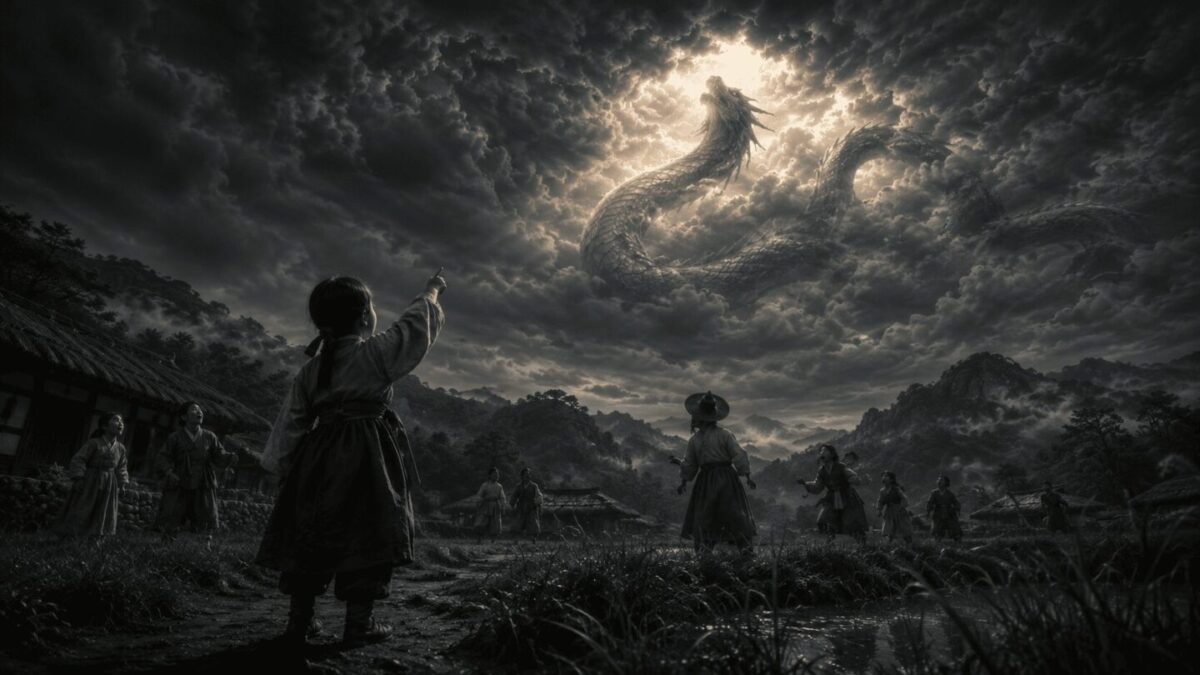
If a human witnesses the imugi rising — in some tellings, if anyone so much as sees it — the ascension collapses. The storm dies. The serpent falls back into the water it spent a thousand years trying to leave, and the count starts over. All that patience, undone not by the imugi’s own failure, but by a stranger’s glance.
The way I heard it as a kid, the rule was even more theatrical. The imugi’s fate hung on what the witness said. If the person — usually, in the tellings I remember, a child — pointed at the sky and shouted “Look, a dragon!”, the transformation held, and the serpent soared. But if they shouted “Look, a snake!”, it was over. Back into the pond. Another thousand years.
I want to be honest about sourcing here, because this blog doesn’t blur that line: that shouted-verdict version is how the story reached me, through picture books and retellings — it’s living oral tradition, and oral tradition never comes in a single authorized edition. I’ve also heard versions where an imugi that commits a sin or harbors malice during its long wait gets its clock reset entirely. The written records generally agree on the core — the long wait, the yeouiju, the catastrophic power of being seen — and the variations braid around it, differing by region, by era, by whichever grandmother was doing the telling.
But think about what that shouted-verdict version actually says. The imugi’s thousand years of discipline come down to a coin flip of human perception. The same creature, at the same moment, is either a dragon or a snake — depending entirely on what someone decides to call it.
Koreans have been telling their children that story for centuries. I don’t think it’s an accident.
“A Serpent That Failed to Become a Dragon”
The imugi left a permanent dent in the Korean language itself.
There’s an old proverb — 용 못된 이무기, roughly “an imugi that couldn’t become a dragon” — and it is not a kind expression. It describes a person who, having failed to rise, turns bitter and spiteful, taking out their frustration on everyone around them. A middle manager passed over for promotion who makes the whole office miserable. That guy.
This is the strange double life the imugi lives in Korean culture. In the stories, it’s a figure of almost unbearable sympathy — a creature that did everything right and got unlucky. In everyday speech, it became shorthand for resentment and pettiness, the sore loser of the animal kingdom. Some folk tales lean into that darker reading too: an imugi denied its ascension doesn’t always retreat gracefully. In some regional traditions it lashes out — scorching fields, souring weather — a supernatural embodiment of thwarted ambition.
Sympathy and contempt, aimed at the same creature. Which, if you think about it, is exactly how we treat human failure too. We weep for the one who almost made it, and we mock them, and sometimes we do both in the same breath.
Still Swimming Through Korean Screens
Here’s what I find remarkable: the imugi never retired.
While researching this piece, I kept running into it everywhere in contemporary Korean media. It has starred as the villain of a hit fantasy drama, anchored a Korean monster blockbuster, and it keeps resurfacing in webtoons — Korean digital comics — where the “serpent who failed to ascend” is practically a stock romantic lead by now: the brooding, cursed, almost-divine figure yearning for the one thing that will complete him. I won’t turn this into a catalog of titles; the point isn’t any single show. The point is that a creature from centuries-old village folklore is still generating new stories in 2026, essentially unchanged: something powerful, something patient, something one heartbeat away from glory — and one wrong word away from losing it all.
Most mythological creatures survive as museum pieces. The imugi survives as a working actor.

Correcting the Record
Now for a section I genuinely enjoy writing — because this time, the English-language internet didn’t just simplify the imugi. It invented a new one.
While researching, I found an English mythology site claiming that a “Korean Sun Goddess” marks certain young girls with a dragon emblem, destining them to transform into imugi at seventeen. Another passage on the same site traces the “first imugi” to a bloody conflict in 420 AD, when the anguish of souls trapped in a cave supposedly congealed into the creature. The same page, describing Korean mythology, casually drops the word “Akuma” — which is Japanese.
Let me be direct: none of this exists in Korean tradition. There is no established Sun Goddess in Korean folk religion handing out dragon tattoos. There is no 420 AD cave-of-souls origin story in any Korean source, classical or folk. These details appear to be invented outright — algorithmically flavored fantasy dressed up as folklore — and the Japanese vocabulary slipping in mid-article tells you how carefully the “research” was done. The actual imugi tradition, documented in Korean references like the Encyclopedia of Korean Culture, needs no embellishment: a serpent, a thousand cold years, a jewel, and the terrible fragility of being seen. That’s the real story, and it’s better than the fake one.
This keeps happening to Korean mythology in English — gaps in translation get filled with fabrication, and the fabrications get copied until they look like consensus. If you’ve read my earlier pieces, you know this is a running theme. Consider this another small correction on the record.
The Dragon That Makes the Myth Work
Here’s the thing I’ve come to believe about why this legend has lasted a thousand years and counting.
Korea has full dragons — majestic, wise, rain-bringing kings of water. And almost nobody tells stories about them. It’s the imugi, the incomplete one, that Koreans can’t stop retelling. Because a dragon that has already ascended has nothing left to want. The imugi is nothing but want — a thousand years of it, coiled in cold water, one glance away from everything.
That’s not a monster. That’s every person who ever studied for an exam that could change their life, waited on a result, built something for years knowing one stroke of bad luck could unmake it. The imugi is the patron creature of the almost — and in a culture that has spent its entire modern history clawing upward against the odds, is it any wonder this is the serpent that stuck?
Somewhere in a cold Korean pond, the story goes, one is still waiting. When it finally rises through the storm — and someday, in some telling, it must — do it a kindness the folklore begs of you:
Call it a dragon.