Chilseong: The Korean Seven Stars God You’ve Walked Right Past
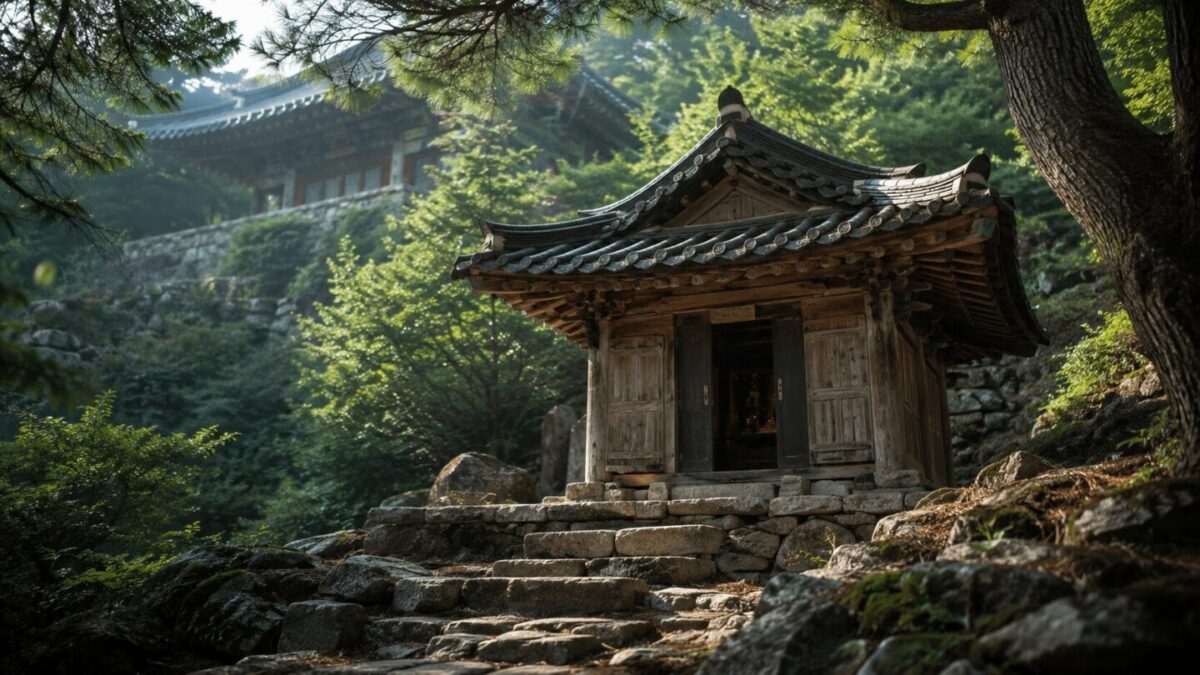
If you’ve ever visited a Buddhist temple in Korea, I can almost guarantee you walked past him.
Behind the grand main hall — the one with the golden Buddhas and the tour groups — there’s usually a much smaller building up a short flight of stone steps. Most visitors never go up. If they do, they glance at the unfamiliar painting inside, take a polite photo, and move on. I’ll admit something: I’m Korean, and if I saw that little hall on a temple trip, I would have walked past it too. I wouldn’t have known what I was looking at.
That building is called a Chilseonggak (칠성각) — the Hall of the Seven Stars. And the god enshrined inside might have the longest continuous history of any deity worshipped on the Korean peninsula. People here have been praying to him since before Korea was Korea.
His name is Chilseong. This is his story — including the parts that are genuinely complicated.
Wait — Was That Him on Netflix?
If you watched If Wishes Could Kill (기리고), the Korean YA horror series that hit #1 on Netflix Korea and #3 globally in 2026, you might have picked up on something: the young shaman Haessal serves a serpent god called Chilseong.
Here’s the thing — that’s him, and also not him. The show’s writer is from Jeju Island, and the production deliberately drew on Jeju’s distinct folk tradition, where Chilseong takes the form of a snake and guards a household’s wealth. The director even said in interviews that this snake worship is rare on the mainland but real on Jeju. It’s a genuinely well-researched detail, and exactly the kind of thing I love seeing in K-content.
But the Chilseong most Koreans’ grandmothers prayed to is a different tradition entirely. On the mainland, Chilseong isn’t a snake. He’s the night sky itself — the seven stars Western readers know as the Big Dipper. That’s the version this article is about. (Jeju’s mythology is its own magnificent rabbit hole, and it deserves its own article someday rather than a rushed paragraph here.)
Who Is Chilseong, Exactly?
Chilseong (칠성) literally means “Seven Stars.” It refers to Bukdu Chilseong (북두칠성) — the Seven Stars of the Northern Dipper, the same seven bright stars of Ursa Major that almost every culture on Earth has named and mythologized.
In Korean folk belief, those seven stars govern the two things human beings have always wanted most: how long you live, and how well you live. Lifespan and fortune. Health and luck. In shamanic tradition, Chilseong is usually thought of as a single deity who appears as seven figures — sometimes painted as seven court officials in flowing robes, sometimes as seven serene Buddhas standing in a row, each with a small star above his head.
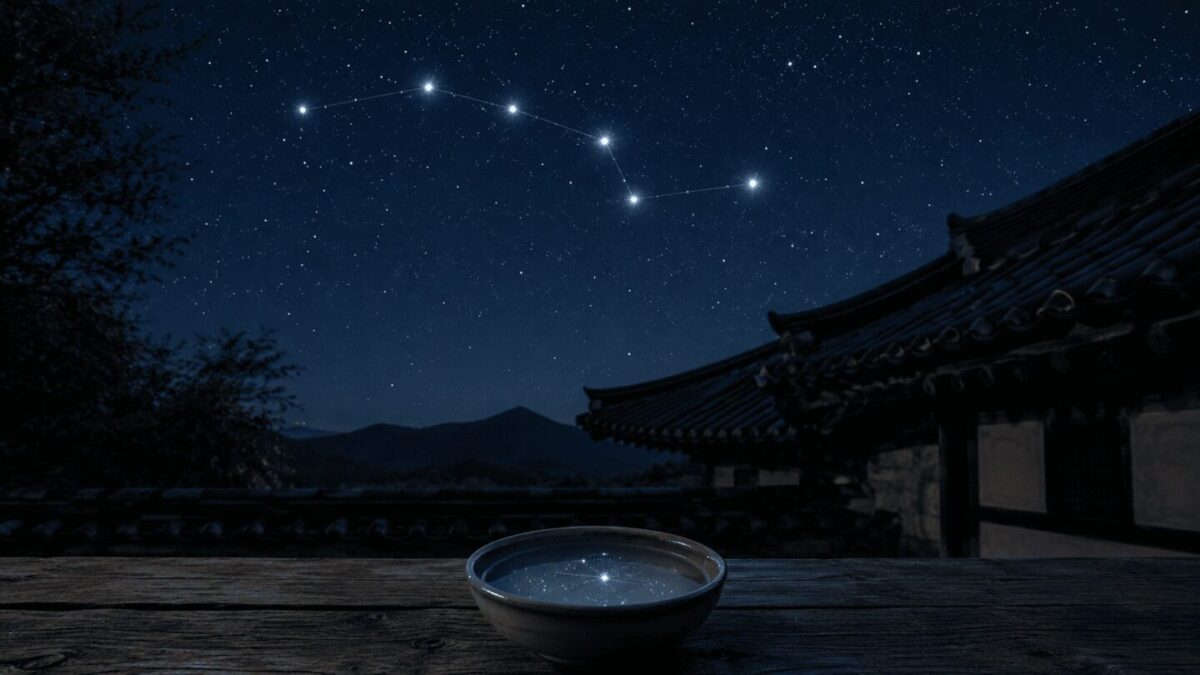
And here’s the image every Korean recognizes, even those of us who never saw it in real life: a mother rising before dawn, placing a bowl of clean, freshly drawn water — jeonghwasu (정화수) — on a platform in the yard, rubbing her palms together, and praying to the seven stars. For a sick child. For a son’s exam. For a safe birth. I never witnessed this in my own family; I know it the way most Koreans my age know it, through period dramas and old films. But that image survives in our collective memory for a reason. For centuries, that bowl of water was where ordinary Korean women — and it was overwhelmingly women — met their god. No temple required. The night sky was the shrine.
Four Thousand Years of Looking Up
This is the part that genuinely stunned me during research.
Koreans have been carving the Big Dipper into stone since the Bronze Age. Dolmens — the massive megalithic tombs that dot the Korean peninsula by the tens of thousands — bear cup-marks on their capstones that archaeoastronomers have identified as star maps, including the unmistakable pattern of the seven stars. Some of these carvings are estimated to be three to four thousand years old. Before Buddhism arrived, before Chinese writing arrived, before any kingdom whose name we know existed here, someone on this peninsula looked up at those seven stars, decided they mattered, and cut them into a tomb.
Notice that detail: into a tomb. Hold that thought — it comes back at the end of this story.
The thread continues almost unbroken. Goguryeo, the ancient northern kingdom, painted the Big Dipper on the ceilings of its tomb murals fifteen centuries ago. Star worship kept absorbing new religious forms through the dynasties that followed. And by the mid-Joseon period, Buddhist temples across the country had begun building dedicated shrine halls for the seven stars — the Chilseonggak I mentioned at the start. Today you’ll find Chilseong enshrined at most Korean temples, either in his own hall or in a Samseonggak (“Three Saints Hall”), sharing the space with Sanshin, the mountain god, and Dokseong, the lonely hermit saint.
Stop and consider how strange that is. Chilseong is not a Buddhist deity. He comes from the folk religion — the shamanic world of the mudang I’ve written about before. Yet Buddhist temples built him a guest room, and he never checked out. Nowhere else does Korea’s talent for religious coexistence show itself so plainly: a shamanic star god, dressed in Buddhist robes, living comfortably inside Buddhist monasteries for four hundred years.
The Myth That Probably Isn’t
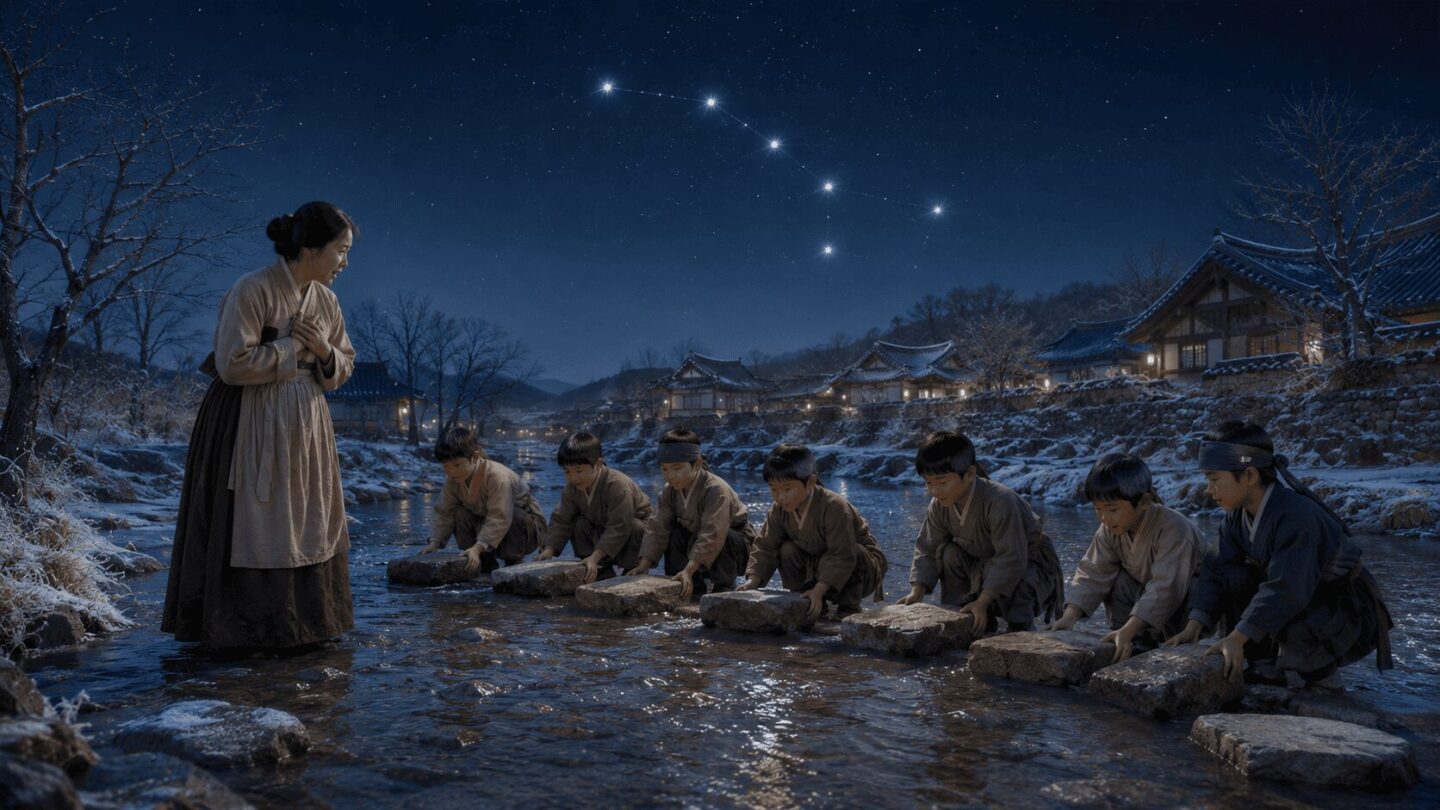
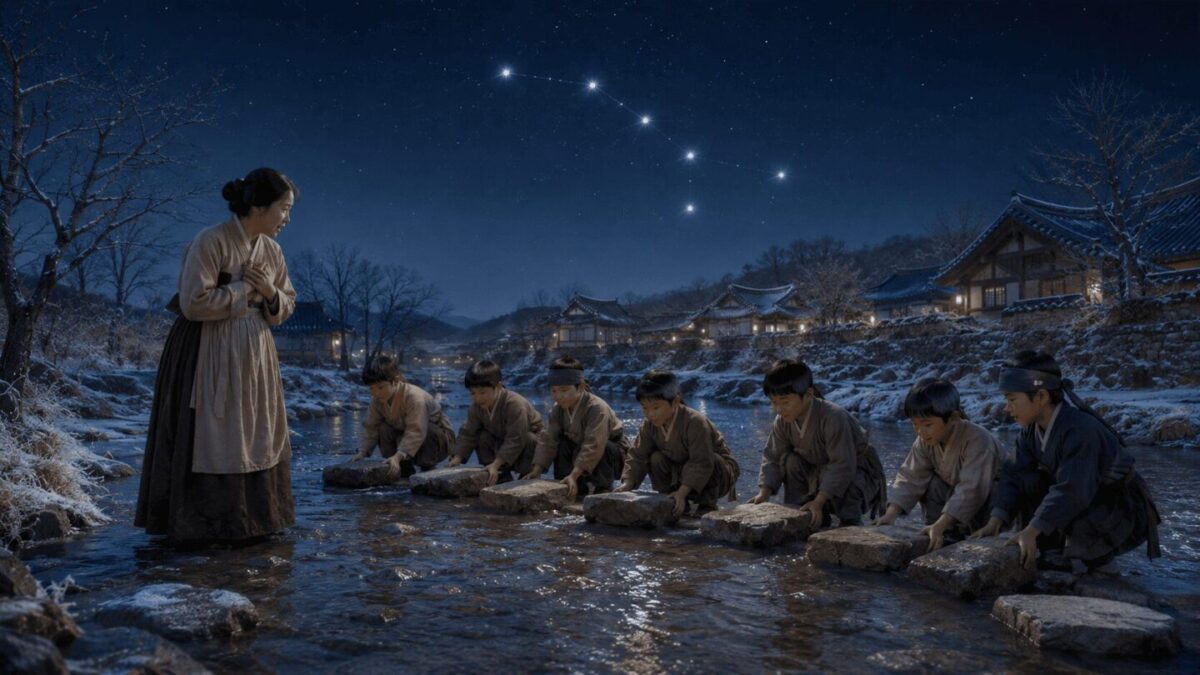
There is a folk tale about how the seven stars came to be. A widow had seven sons. Every night, she secretly crossed an icy stream to visit a man in the next village. Her sons, worried about their mother’s freezing feet, laid stepping stones across the water without telling her. The mother, moved by the mysterious kindness, blessed whoever placed the stones — and the seven devoted sons eventually rose into the sky as the seven stars.
It’s a lovely story. I’d genuinely enjoy telling you it’s the official origin myth of Chilseong. But honesty first: even Korean sources flag this tale as nearly impossible to verify and quite possibly a much later invention, pasted onto a star cult that is thousands of years older than any folktale about it. The worship came first — probably by millennia. The bedtime story came later.
I mention it anyway because the tale accidentally captures something true: in Korea, the seven stars were always about family. About mothers and children, devotion and protection. Whoever invented that story understood exactly what Chilseong meant to the people who prayed to him.
An Honest Complication
Now for the part where I have to resist writing the article I wanted to write.
When I covered Samsin Halmoni, Korea’s childbirth goddess, I got to correct an English-language source that wrongly labeled her a Chinese import. I’d love to do the same trick here — plant the flag and declare Chilseong one hundred percent homegrown. Some English sources do flatly call him “Taoist in origin,” and my first instinct was to push back hard.
But the honest picture is more tangled, and you deserve the tangled version.
The impulse — Koreans looking up at the seven stars and finding meaning there — is genuinely ancient and genuinely local. The Bronze Age dolmen carvings predate any documented Chinese religious influence on the peninsula. Nobody imported the night sky.
The system, though — the elegant framework where seven named star-lords govern human fate, the iconography of star-Buddhas, the temple rituals — that arrived through centuries of exchange with Chinese Taoism and esoteric Buddhism, which blended with the older native star veneration until the layers fused. Scholars of Korean Buddhism describe the Chilseong worshipped in temples today as exactly this kind of composite: an ancient Korean shamanic deity wearing imported vestments.
So which is he — indigenous or imported? The question itself is slightly wrong. Chilseong is what happens when a people keeps worshipping the same seven stars for three thousand years while empires, religions, and dynasties wash over them. Each era added a layer. None of them managed to replace the core. If anything, that makes him more Korean, not less — because that pattern, absorbing everything while surrendering nothing, is the story of Korean culture itself.
From the Rice Jar to the Seven-Star Board
Remember the detail from the Bronze Age — the stars carved into tombs? Here’s where it comes back.
In my article on Samsin Halmoni, I wrote about the samsin danji, the humble jar of rice that housed the goddess of birth in the corner of a Korean home. One folk tradition holds that Samsin Halmoni watches over a child until around the age of seven, and then hands the watch to Chilseong — the seven stars taking over from the grandmother. I should be straight with you: that clean handoff is one strand of folk belief among several, not settled doctrine. Korean folk religion was never a single organized system with a rulebook.
But the deeper symmetry is real, and it’s documented in a startling place: the coffin.
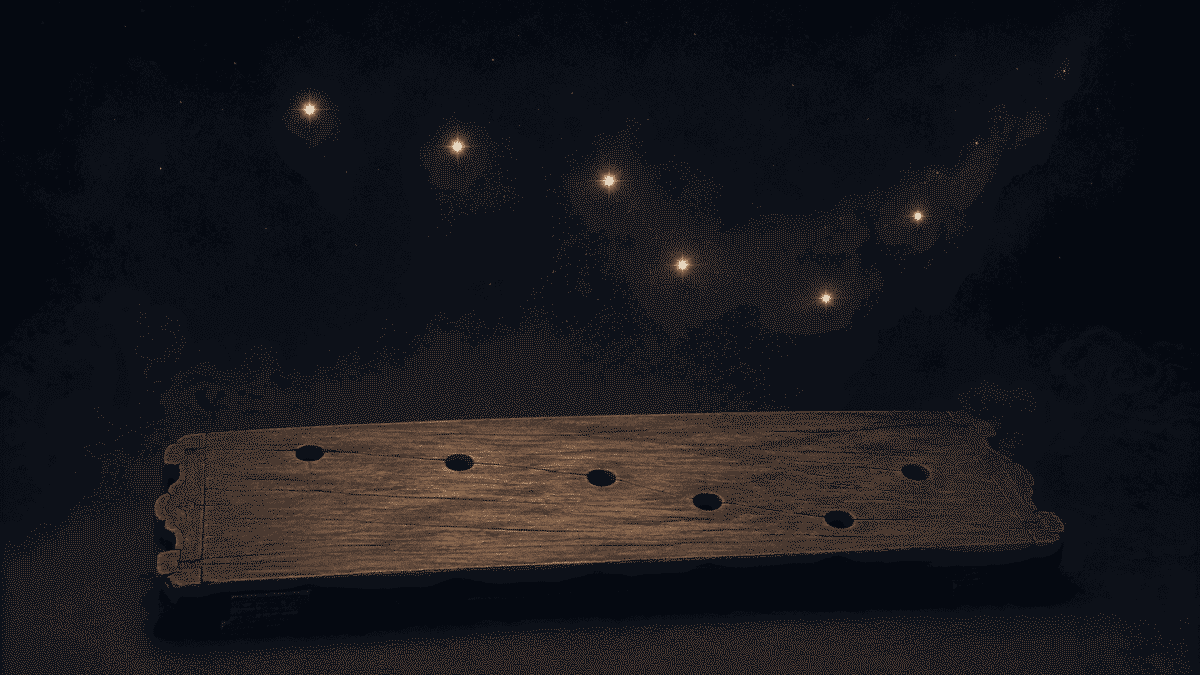
In traditional Korean funerals, the deceased was laid upon a wooden board called a chilseongpan (칠성판) — the “seven-star board” — drilled with seven holes in the exact pattern of the Big Dipper. The dead literally rested on the stars. The belief, documented by the National Folk Museum of Korea, was that the board entrusted the departed to the same seven stars that had watched over them in life.
The Korean language once carried this in its bones. There were old expressions like “he crossed the seven-star board,” meaning someone had brushed against death. I’ll be honest with you again: I’m Korean, and I have never once heard anyone say this in real life. The phrase is essentially dead — a fossil that survives in dictionaries and folklore archives, not in conversation. The board itself has largely vanished from modern funerals too.
But sit with the original picture for a moment, because I think it’s one of the most beautiful ideas in Korean folk religion. A rice jar received you into the world. A star board carried you out of it. From the grandmother goddess of the birthing room to the seven stars over the grave, Korean folk belief wrapped an entire human life — first breath to last — in a single, continuous embrace of guardianship. The universe, in this view, was not indifferent. It had been assigned to your case.
The God Behind the Door
So why did Chilseong fade?
Partly for the same reason Samsin Halmoni did: gods of quiet protection don’t generate dramatic stories, and gods without dramatic stories don’t get retold. Partly because the practices that carried him — the dawn bowl of water, the seven-star board — belonged to a rhythm of life that industrial Korea left behind in a single generation.
And yet. The halls are still there, at nearly every temple in the country, repainted and cared for. Mothers still pray at them before college entrance exams — the wish list has updated, but the address hasn’t changed. A snake-form cousin of his just co-starred in a global Netflix hit. Four thousand years in, Chilseong is diminished, blended, half-forgotten — and still on duty.
The next time you visit a Korean temple, look for the small hall behind the main one, up the stone steps, past where the tour groups stop. Now you know who lives there. That puts you ahead of most visitors — and, honestly, ahead of the person writing this, up until very recently.
He’s been watching over people here for a very, very long time. The least we can do is stop walking past.