Samsin Halmoni: The Korean Grandmother Goddess Everyone Knows and No One Can Explain
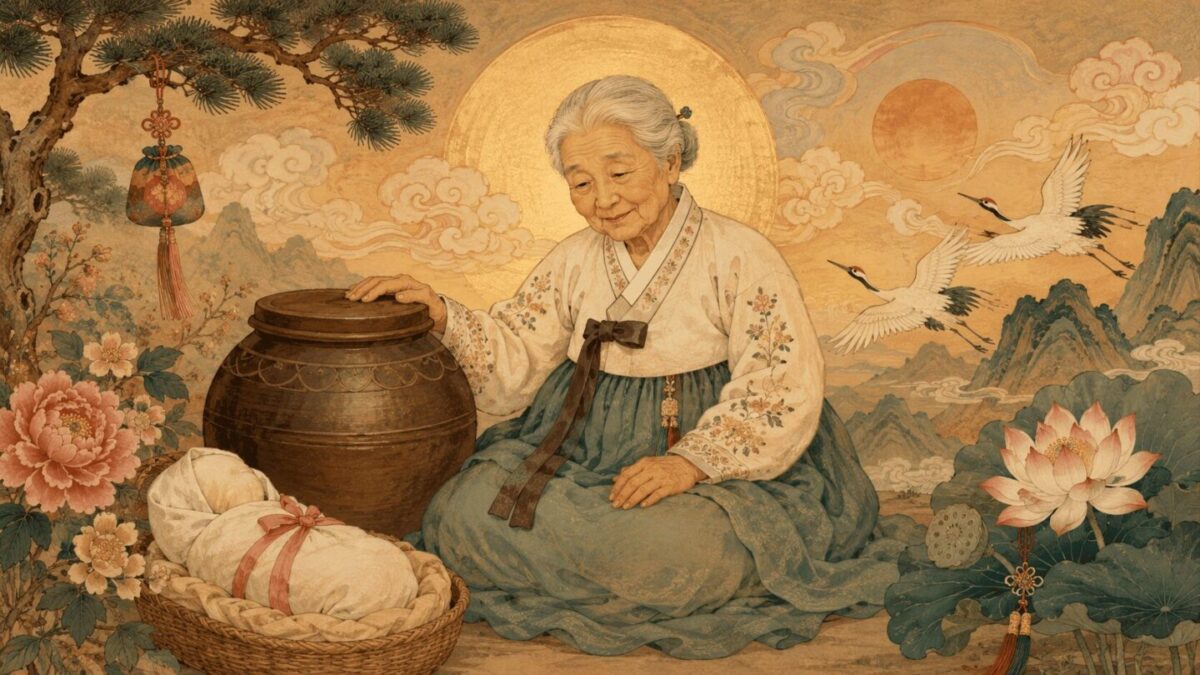
Ask any Korean who Samsin Halmoni is, and you’ll get the same answer: “Oh, the childbirth grandmother. Everyone knows her.”
Then ask a follow-up question. Where does she come from? What’s her story? Why is she a grandmother and not, say, a young mother?
Silence.
I’ll be honest with you — I was part of that silence. I grew up hearing the name Samsin Halmoni the way you might grow up hearing about a distant great-aunt: constantly referenced, never actually explained. When I started researching this article, I was convinced she was a Jeju Island deity. I’m not from Jeju, so I assumed that was why I didn’t know her story. I was wrong. There’s a Jeju version, yes — but Samsin Halmoni has been quietly watching over births on the Korean mainland for centuries, including, presumably, mine.
That’s the strange thing about her. She may be the most invoked and least understood goddess in all of Korean mythology. Her name survived. Her story almost didn’t.
So let me tell you the story — the one most Koreans never learned.
You’ve Already Met Her (If You’ve Watched Goblin)
If you’ve seen the 2016 tvN mega-hit Goblin: The Lonely and Great God, you’ve already met Samsin Halmoni — you just might not have realized who she was.
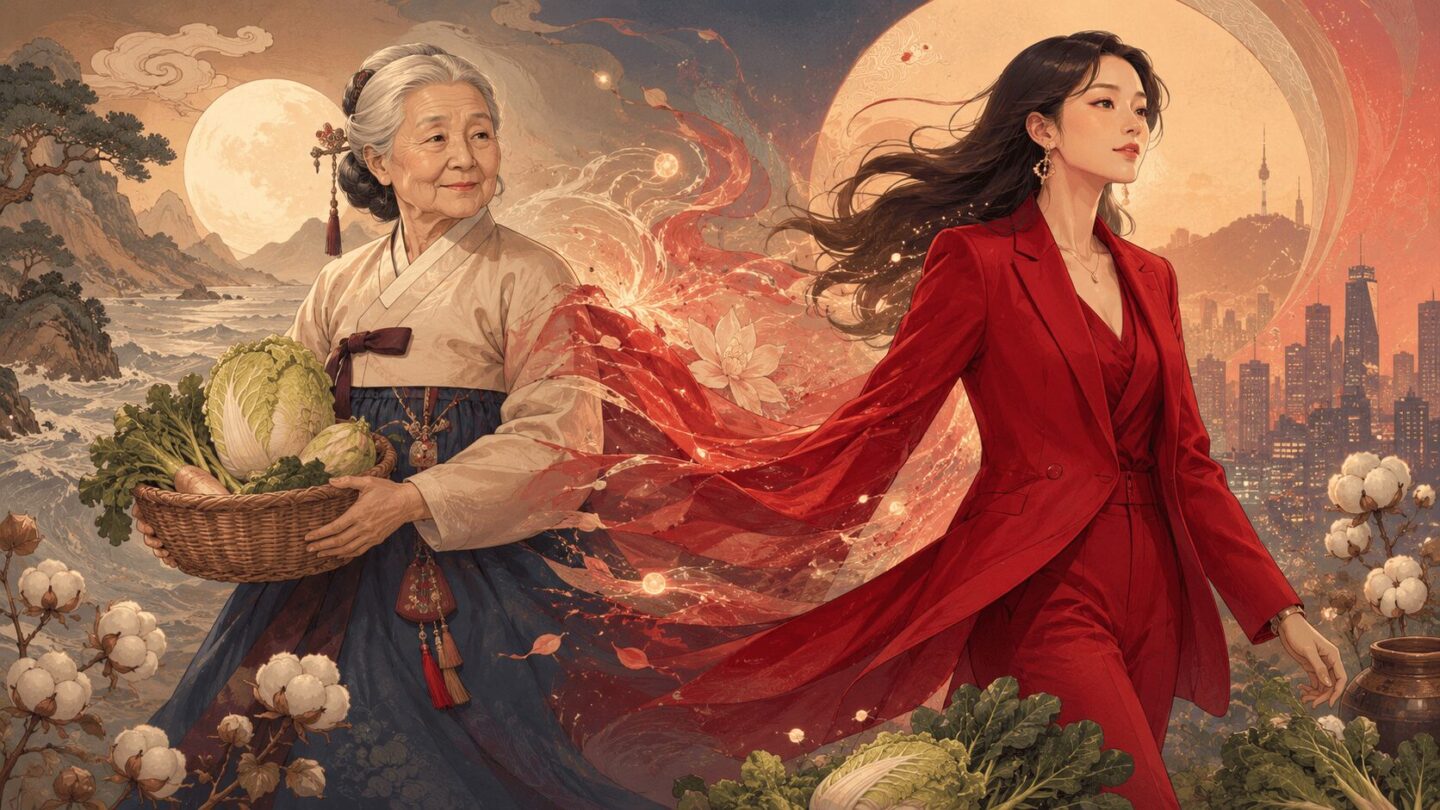
Remember the mysterious old woman who appears at the exact moment young Ji Eun-tak is about to be taken by the Grim Reaper? The one who shoos death itself away like it’s a stray cat, then walks off and transforms mid-stride into a stunning woman in a red suit? That’s her. Played by actress Lee El, the character switches between a wrinkled grandmother and a glamorous woman in red — and Korean viewers instantly knew who she was without a single line of explanation.
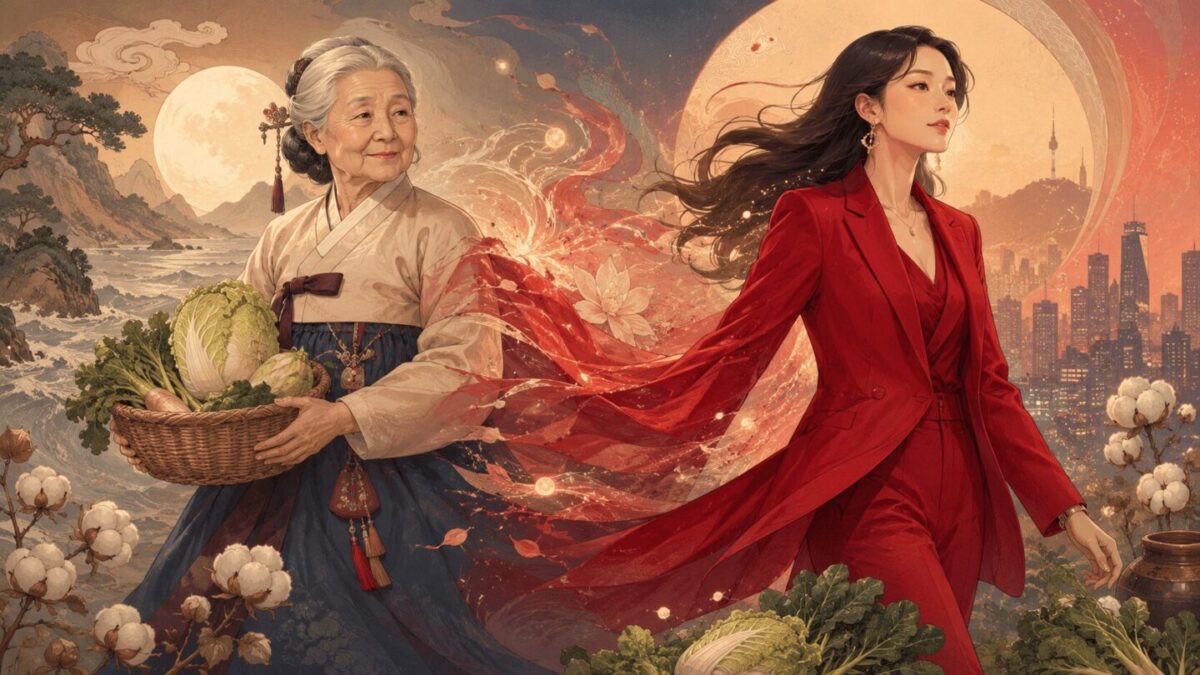
Two details in that drama were love letters to Korean viewers. First, she hands out cabbage and spinach — humble vegetables — which later turn out to matter in the plot. Gods in Korean folklore don’t give gold; they give you what a grandmother would give you. Second, in the finale she hands the heroine cotton flowers. In the Korean language of flowers, cotton blossom means a mother’s love. She was never Eun-tak’s mother. She was something older than that.
That’s Samsin Halmoni in one image: the deity who loves you like family, whether or not you remember she exists.
So Who Is She, Exactly?
Samsin Halmoni (삼신할머니) is the goddess of childbirth, conception, and the survival of young children in Korean folk belief. Break the name down and you get Samsin — the “Sam” is usually linked to pregnancy or the number three, depending on which tradition you follow — and Halmoni, which simply means grandmother.
And that last part matters. In Korean folk religion, calling a goddess “grandmother” isn’t about age — it’s a title of veneration. The grandmother is the one who has seen everything, fears nothing, and will fight anyone who threatens her family. When Koreans imagined the being responsible for safely delivering babies into a world full of disease and danger, they didn’t imagine a warrior or a queen. They imagined the toughest, warmest figure they knew.
Her job description, in traditional belief, covered the entire danger zone of early life:
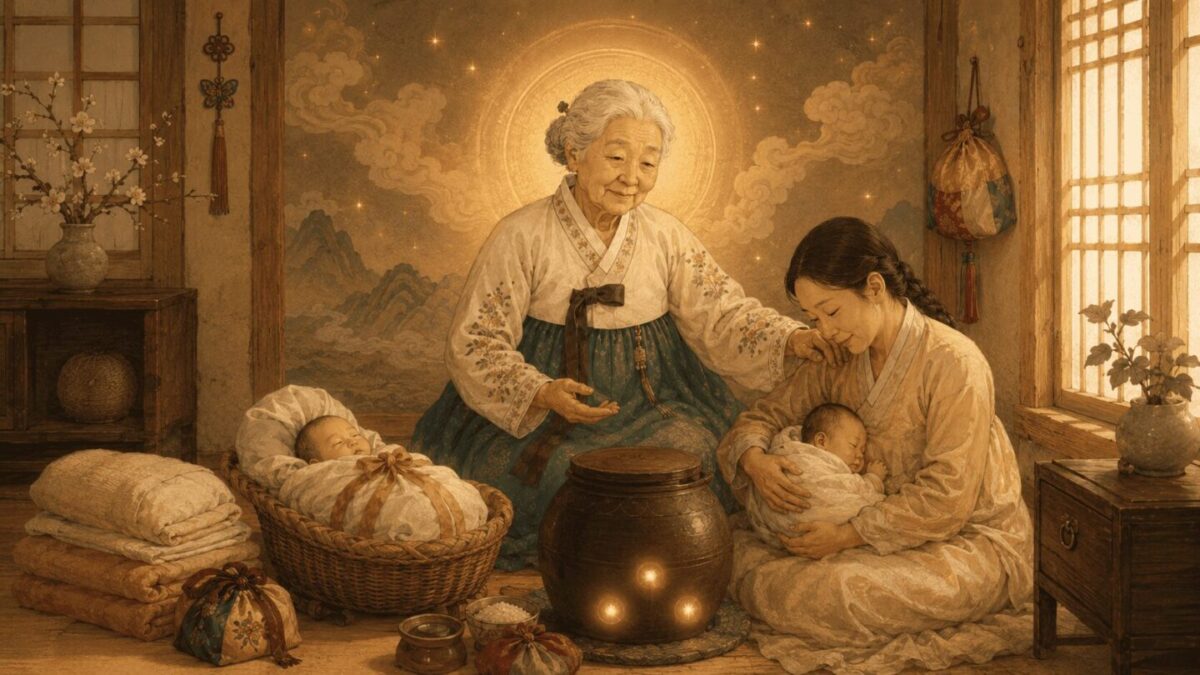
She decides conception — in old Korean, a child isn’t just “born,” a child is jeomji (점지), meaning personally selected and granted by Samsin. She protects the mother through pregnancy and delivery. And she guards the child through the most fragile years — traditionally until around age seven, when another deity, the Seven Stars spirit Chilseong, takes over the watch. (Chilseong deserves an article of his own, and he’ll get one.)
If you’ve read my earlier piece on mudang, Korea’s shamans, this structure will feel familiar — Korean shamanism organizes the divine world like an extended household, with different deities responsible for different rooms of human life. Samsin Halmoni owns the nursery.
The Myth Most Koreans Never Learned
Here’s where it gets interesting — because Samsin Halmoni does have an origin story, preserved in shamanic narrative songs (muga) that were passed down orally for centuries.
The best-known mainland tradition ties her to a figure named Danggeum-aegi, a noble maiden whose story survives in the shamanic epic tradition. While the details shift from region to region — these stories lived in the mouths of shamans, not in books, so no two provinces tell it quite the same way — the broad arc goes like this: a sheltered young woman becomes pregnant under extraordinary circumstances, is cast out by her own family for it, survives disgrace and exile, gives birth alone, and through that ordeal is elevated into the very deity who governs birth itself.
Sit with that for a second. The goddess of childbirth isn’t a serene celestial queen who descended from heaven on a cloud. In the dominant telling, she’s a woman who went through the worst that her society could inflict on a mother — shame, abandonment, birth without help — and came out the other side as the protector of every mother after her.
I don’t think that’s a coincidence. Korean shamanism has always been unusually female — most shamans were and are women, and its gods reflect the concerns of the women who kept the tradition alive. A birth goddess forged through suffering is exactly the deity that generations of Korean mothers, facing real childbirth in an era of real mortality, would trust.
One honest caveat, because this blog doesn’t do false certainty: the mythology here is genuinely tangled. Regional versions differ on who Samsin originally was, whether she is one goddess or three, and how the Danggeum-aegi narrative connects to her. Jeju Island has its own tradition — there she’s called Samseung Halmang, with a distinct myth of her own — and that’s a story big enough to deserve separate treatment someday. What I’ve given you is the mainland thread, told at the level scholars can actually support.
How Koreans Actually Worshipped Her
This is my favorite part, because it shows what Korean folk religion really looked like: not temples and priests, but rice jars and ropes.
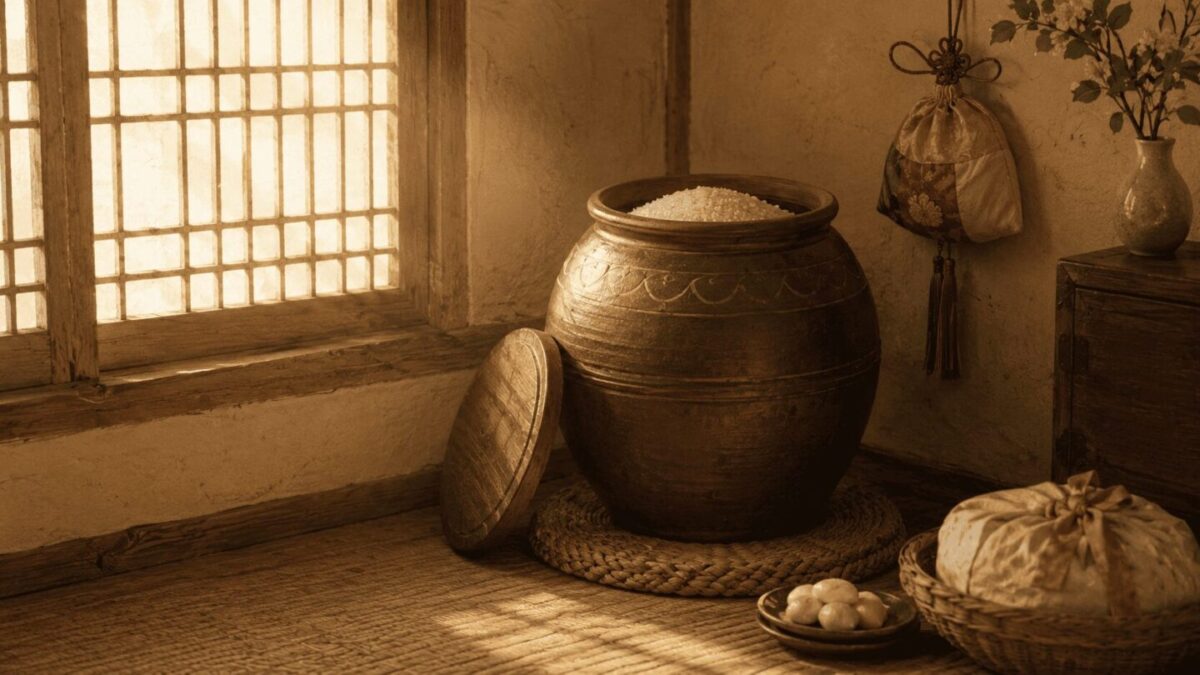
The rice jar in the corner. Many households kept a samsin danji — an earthenware jar filled with rice, kept in the inner room of the house. That jar was her seat in the home. No statue, no shrine, no incense. A jar of rice. The goddess of new life was housed in the thing that sustains life. There’s an entire philosophy in that choice.
The rope across the gate. After a birth, families hung a twisted straw rope called a geumjul across the front gate. It announced the birth, and it warned outsiders — and the illnesses and ill fortune they might carry — to stay away. In an age when a newborn’s survival was genuinely uncertain, the geumjul turned the whole house into protected territory.
The first hundred days. The most fragile period was the first hundred days, and the baek-il (100th day) celebration — which Korean families still hold today — was originally a thanksgiving. If you’ve ever wondered why Koreans throw a party for a 100-day-old baby, this is why: it marked surviving the window when Samsin Halmoni’s protection mattered most. Modern parents book a photo studio. Their great-grandmothers offered rice and seaweed soup to the grandmother goddess.
That’s the quiet punchline of this whole article: Koreans still perform her rituals. The baek-il party, the seaweed soup after birth — the customs outlived the goddess. Millions of Korean families honor Samsin Halmoni every year without knowing that’s what they’re doing.
Correcting the Record
One more thing, and this is the part where being a Korean writing in English becomes an unfair advantage.
While researching, I found English-language mythology sites claiming that Samsin Halmoni “originated in Tang Dynasty China” before being adopted into Korea. Let me be direct: that claim doesn’t hold up. Samsin belief is rooted in Korean shamanism — the same indigenous tradition I covered in the mudang article — and Korea’s own authoritative folk-culture references, like the Encyclopedia of Korean Folk Culture published by the National Folk Museum of Korea, document her as a native shamanic and household deity. Korean shamanism absorbed influences over the centuries, as every living tradition does. But a Chinese import she is not.
This keeps happening with Korean mythology in English. Sources copy each other, errors fossilize, and there aren’t enough Koreans writing in English to push back. Consider this article a small push.
The Grandmother Who Stayed
Why did Koreans forget her story but keep her name?
My theory: because she did her job too well. Gods with dramatic stories — the underworld messengers, the nine-tailed fox — get retold because their stories are entertaining. (If you want Korean supernatural beings with more bite, my gumiho article is where the teeth are.) Samsin Halmoni’s domain was quieter: healthy births, surviving babies, the crisis that didn’t happen. Nobody writes epics about disasters averted.
But she stayed anyway. In the baek-il photos on every Korean family’s wall. In the seaweed soup every Korean mother eats after giving birth. In a red-suited scene-stealer in one of the biggest K-dramas ever made. And in the phrase Korean grandmothers still use when they see a baby that was hoped for and waited for: Samsin halmoni-ga jeomji-haetda — “Samsin Halmoni granted this child.”
Everyone knows her name. Now you know her story — which puts you, honestly, ahead of most of us.