Korean Yeot: The Good-Luck Candy That’s Also an Insult

When I was a kid, I watched younger students crowd around the older ones on the morning of Korea’s big college entrance exam and press something into their hands. Not flowers. Not notes. A stick of Korean yeot — a chewy, amber-colored taffy that clings to your teeth like it has something to prove. The message was simple: stick. Stick to your answers. Stick to the university you want. In Korean, the word for “sticking” is the same word we use for “passing” an exam.
That’s the sweet version. Here’s the other one: hand someone that exact same candy in a different mood, tell them to eat it, and you’ve just said f*** you.
Same candy. Opposite meanings. And the story of how Korea ended up with both involves a single test question, a crowd of furious parents, a court case, and a sticky protest that people still tell stories about sixty years later.
One Candy, Two Meanings
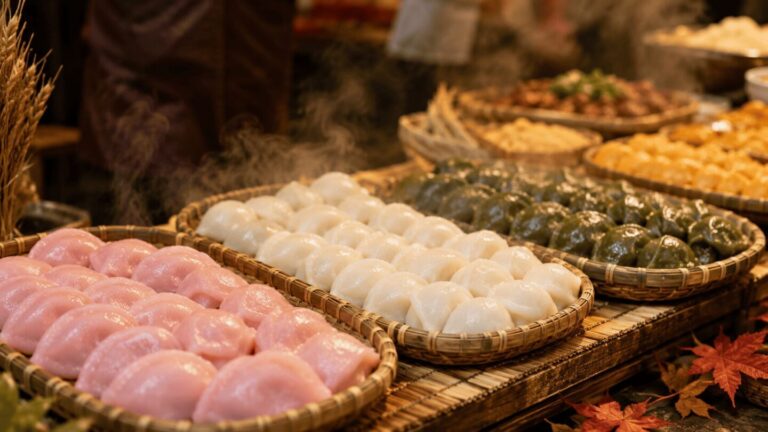
First, the candy itself. Korean yeot is a traditional sweet made by slowly cooking grains like rice down into a thick syrup, then pulling and hardening it into sticks or slabs. Think saltwater taffy with the patience of a grandmother. It’s been around for centuries, sold by street vendors who used to clack big scissors to announce they’d arrived.
Now the two meanings.
The blessing. The Korean verb butda means “to stick” — and it also means “to pass” a test. So before Korea’s national college entrance exam, the Suneung, parents, friends, and younger students hand out yeot to test-takers. The candy sticks; so should you. It’s the most Korean kind of joke: a pun you can eat.
The curse. “Yeot meogeora” — literally, “Eat yeot” — is a Korean insult. Depending on how it’s said, it lands anywhere from “screw you” to a full f*** you, and it’s one of the few Korean swears that most Koreans, even grandmothers, will recognize instantly. There’s also a softer spin-off, “yeot meogida” — “to feed someone yeot” — which means to trick someone or leave them holding the bag.
If you’ve read my piece on how Korean packs whole situations into tiny bits of slang, you know Korean loves a double meaning. But this one is special, because it comes with a backstory — and that backstory starts in a classroom in 1964.
1964: The Candy Question That Broke Seoul
Picture it: December 1964, Seoul. Back then, getting into a top middle school was a make-or-break moment for a Korean twelve-year-old — the elite middle schools fed into the elite high schools, which fed into the elite universities. Parents treated it the way some American parents treat Ivy League admissions today, except the kids were in sixth grade.
On the science section of that year’s middle school entrance exam, question 18 asked something like this:
When making yeot, which of the following can be used instead of malt?
The official answer was diastase — an enzyme that breaks starch into sugar. Simple enough.
Except one of the other answer choices was radish juice. And plenty of kids had chosen it — because radish juice also contains diastase. It wasn’t a wild guess. It was, by some accounts, right there in their own school science textbooks.
The education authorities marked radish juice wrong anyway.
Imagine one SAT question deciding whether your kid gets into the school that’s supposed to shape their whole life — and then imagine finding out the “wrong” answer your kid gave actually works. Now multiply that by hundreds of families. You can probably guess what happened next.

The Radish Juice Rebellion
The parents of the kids who’d missed the cut by that one question didn’t write a polite letter.
They went into their kitchens, took radishes, squeezed out the juice, and made yeot with it. Then they carried their homemade radish-juice candy to the education authorities and confronted the officials face to face. The message, according to the story as it’s been told ever since, was pure Korean sarcasm: Go on. Eat the yeot. Taste it. Tell us radish juice doesn’t work.
It turned into a legal fight. The case went to court, and the court sided with the parents: radish juice counted as a correct answer. Thirty-eight students who had been rejected over that single question were admitted.
And then the story got worse — for the adults in charge. In the confusion of squeezing those extra students into schools, it came out that some children from powerful, well-connected families had slipped in through the back door too. The scandal cost senior officials their jobs, including Seoul’s top education official and a vice minister of education.
The fallout didn’t stop there. A few years later, in 1968, the government announced it was abolishing entrance exams for middle school altogether.
So, to recap: one question about candy made parents cook candy in protest, dragged the government into court, exposed a corruption scandal, and helped end an entire national exam system. Not bad for a radish.

So… Did This Invent the Insult?
Here’s where most blog posts about Korean yeot tell you a tidy story: the parents yelled “eat yeot!” at the officials, and that’s how the insult was born.
It’s a great story. It’s also, as far as anyone can prove, not true.
Korean newspapers and language experts have pointed out that “eat yeot” was already being used before 1964 — as a way to shut down someone who was talking nonsense, something like “I don’t want to hear it, go eat some yeot.” Even Korea’s National Institute of Korean Language, the country’s official language authority, has warned that neat origin stories tying expressions to famous historical events can be convincing and still mislead people.
There are other theories, too. A popular one claims yeot was once slang among traveling folk performers for something much less innocent than candy — but nobody has produced solid written evidence for it, so treat it as gossip, not history.
So here’s the honest version: the 1964 exam scandal probably didn’t create the insult. What it did was give the phrase the best story in the Korean language — the one every Korean eventually hears, and the reason the insult feels so perfectly aimed at people in power who get it wrong.
Sometimes the legend isn’t the origin. It’s just the version everybody remembers.
The Candy Comes Back: A Shower of Yeot at the Airport
Fifty years after the radish juice rebellion, Korean yeot made the evening news again.
In June 2014, South Korea’s national soccer team came home from the World Cup in Brazil after a miserable showing — out in the group stage without a single win. At the airport welcome event, some fans had come prepared. As the players stood waiting for photos, the fans threw yeot at them.
No one needed to explain it. Every Korean watching understood exactly what was being said, in the rudest, stickiest way possible.
And the memory has stuck around. This year, 2026, after another early World Cup exit, the team came home without holding any public airport event at all — and the press in Korea and even Japan immediately brought up the 2014 yeot shower. Nobody officially said the candy was the reason. Nobody had to.

Back to the Exam Morning
This year’s Suneung falls on November 19. Early that morning, all over Korea, students will walk through school gates past crowds of younger kids, parents, and teachers — and somebody will press a piece of Korean yeot into their hands.
Most of those test-takers won’t think about 1964. They won’t picture parents squeezing radishes, or a courtroom, or a soccer team ducking flying candy at an airport. They’ll just feel the stick of sugar and the weight of everyone’s hope.
But I think about it now whenever I see that candy. It’s a strange little object. The same sweet has carried a whole country’s exam anxiety in both directions: the desperate hope of please pass, and the furious protest of you got it wrong — now eat it.
Only in Korea could good luck and a middle finger come in the same wrapper.

Korean yeot (엿) is a traditional Korean confection made by boiling down steamed grains into a thick syrup. It is given to students before the Suneung college entrance exam as a pun on butda (“to stick” / “to pass”), while the phrase “yeot meogeora” (“eat yeot”) is a common insult. A popular story links the insult to the 1964 Seoul middle school entrance exam “radish juice” scandal, but the expression was already in use before 1964, and its true origin remains uncertain.